Central to the new frontiers of many-particle quantum physics is the time evolution of entanglement. Stemming from various dynamical processes of information, fluctuations in entanglement evolution differ conceptually from out-of-equilibrium fluctuations of traditional physical quantities. We report a counterintuitive fundamental result in the dynamics of quantum entanglement that connects two seemingly unrelated fields, mesoscopic fluctuations in electronic systems and entanglement dynamics. The underpinning of such phenomenon is an emergent random structure in the evolution of the many-body wavefunction in two classes of integrable --- either free fermions or interacting spins --- lattice models. For each class, it leads to a universal scaling law for the variance in the long-time statistics of entanglement evolution, and the full distribution displays a sub-Gaussian upper and a sub-Gamma lower tail. These statistics are independent of both the system's microscopic details and the choice of entanglement probes. Our results have practical implications for controlling entanglement in mesoscopic devices and lay a theoretical foundation for understanding fluctuations observed in experiments using various quantum simulation platforms.
Ref: Lih-King Lim, Cunzhong Lou, Chushun Tian, https://doi.org/10.48550/arXiv.2305.09962
Intracellular fluids, e.g. the eukariotic cytoplasm, are crowded with a plethora of macromolecules, bearing similarities to semidilute polymer solutions. Since many of the macromolecules are actively driven by ATP hydrolysis, these crowded living fluids are also equipped with genuine non-equilibrium properties. Using model systems from culture cells to extracts, we have explored fluctuation-driven transport and the self-organized formation of compartments in living fluids. As a result, we have observed via extensive single-particle tracking experiments that the generic mode of motion in the cytoplasm appears to be a driven, anti-persistent, and partially intermittent fractional Brownian motion process. On larger length scales, we have observed that a spontaneous, ATP-driven compartmentalization in cell extracts without priming template structures, features geometric properties and a dynamic coarse-graining like two-dimensional foams. Altogether, our experimental observations suggest that fluctuation-driven transport and self-organized space compartmentalization in living biofluids are well captured by few but robust physico-chemical principles.
In the last 30 years, gases of neutral atoms cooled in regimes of quantum degeneracy allowed the experimental realization of several paradigmatic concepts of theoretical physics. The list includes Bose-Einstein condensation, the unitary Fermi gas, the BCS-BEC crossover, quantum phase transitions, and artificial gauge fields. Among the multitude of topics that are nowadays explored, I will focus in my talk on two research lines to which I contributed:
1) Atomic gases in curved geometries: how does the quantum physics of a bosonic gas interplay with its confinement on a curved manifold? I will first introduce the field and discuss a few results for attractive bosons on the surface of a sphere. I will in particular show how tuning the radius of the sphere produces a first-order phase transition from a localized state to a uniform gas.
2) Mixtures of fermions with zero-range interspecies attraction: how many heavy fermions can be bound by a single light fermion? I will introduce the research problem and provide exact and mean-field results for the energy and the density of these bound states, both in 1D and in 2D.
References:
[1] A. Tononi and L. Salasnich, Low-dimensional quantum gases in curved geometries, Nature Reviews Physics 5, 398 (2023).
[2] A. Tononi, G. Astrakharchik, D. S. Petrov, Gas-to-soliton transition of attractive bosons on a spherical surface, arXiv:2312.04984.
[3] J. Givois, A. Tononi, D. S. Petrov, Heavy-light N+1 clusters of two-dimensional fermions, arXiv:2310.11330.
[4] J. Givois, A. Tononi, D. S. Petrov, Self-binding of one-dimensional fermionic mixtures with zero-range interspecies attraction, SciPost Phys. 14, 091 (2023).
[5] A. Tononi, J. Givois, D. S. Petrov, Binding of heavy fermions by a single light atom in one dimension, Phys. Rev. A 106, L011302 (2022).
I will present a family of quantum kinetically constrained models (KCMs) arising through duality from the Heisenberg XXZ spin chain. Mimicking excluded-volume constraints typical of classical structural glasses, kinetic constraints crucially affect the dynamics of quantum KCMs. Their intriguing feature is that the integrable and nonintegrable deformations around the classical stochastic point give rise to ground state phase transitions between localised and delocalised phases, which in turn determine the nature of quantum dynamics at finite energy densities. I will describe the main features of the dynamics in each phase and discuss the connection to the corresponding classical stochastic models, where the emergent “dynamical" phase transition can be understood through statistical ensemble description of trajectories. Finally, if time permits, I will discuss relation to the Hilbert space fragmentation arising in the exactly solvable large-coupling limits of the considered quantum kinetically constrained models.
The Vicsek simulation model of flocking together with its theoretical treatment by Toner and Tu in 1995 were two foundational cornerstones of active matter physics. However, despite the field's tremendous progress, the actual universality class (UC) governing the scaling behavior of Viscek's "flocking" phase remains elusive. Here, we use nonperturbative, functional renormalization group methods to analyze, numerically and analytically, a simplified version of the Toner-Tu model, and uncover a novel UC with scaling exponents that agree remarkably well with the values obtained in a recent simulation study by Mahault et al. [Phys. Rev. Lett. 123, 218001 (2019)], in both two and three spatial dimensions. We therefore believe that there is strong evidence that the UC uncovered here describes Vicsek's flocking phase.
LAST-MODIFIED:20241010T150907Z SEQUENCE:21448762 X-ACCESS:1 X-HITS:951 X-COLOR:3366cc X-SHOW-END-TIME:1 END:VEVENT BEGIN:VEVENT DTSTART;TZID=Europe/Paris:20240226T104500 DTEND;TZID=Europe/Paris:20240226T114500 UID:BF649E9F-A051-48CD-A563-6EE969CD978C SUMMARY:Éric Clément (PMMH-ESPCI-PSL, Sorbonne University, University Paris-Cité, Paris) CREATED:20240205T091128Z DTSTAMP:20240205T091128Z URL:https://www.lptmc.jussieu.fr/vie-scientifique/listeseminaires/eric-clement-pmmh DESCRIPTION:Bacteria exploring Newtonian and non-Newtonian complex fluids: from behavioral variability to medium assisted tumbling\N \NUnderstanding the way motile micro-organisms such as bacteria explore their environment is central to many ecological, medical and biotechnological issues. Here, I will present recent advances on the kinematics of bacteria such as E.coli, undergoing sequences of runs and tumbles which finally lead to a random-walk exploration process. The extreme sensitivity of the flagella motor rotation switch to the presence of a phosphorylated protein in its vicinity, inherently leads to a behavioral variability of the run-times characterized by a non-Markovian memory and a large log-normal distribution [1]. This mechanism prevails in most Newtonian fluids with important consequences on the residence times at surfaces [2] as well as on the large scale dispersion properties in confined environments [3].\NHowever, when the surrounding fluid is a yield-stress fluid, the locally high resistance to penetration takes control of the exploration process. The presence of mechanical heterogeneity coupled to the bending of the flagella bundle, takes control of the bacteria reorientation eventually leading to a reduction of the run persistence times, the emergence of transient trapping and finally, the onset of a motility barrier. Those mechanisms we describe as «medium assisted tumbling» are cruicial to understand the penetration process and trapping of bacteria in many biological situations such as in mucus layers an important line of defence of epithelial cells in the intestinal track.\NReferences:\N[1] N. Figueroa-Morales et al Phys.Rev.X, 10, 021004 (2020).\N[2] G.Junot et al., Phys.Rev.Lett., 128, 248101 (2022).\N[3] N.Figueroa-Morales et al; Science Advances, 6, eaay0155 (2020). X-ALT-DESC;FMTTYPE=text/html:
Understanding the way motile micro-organisms such as bacteria explore their environment is central to many ecological, medical and biotechnological issues. Here, I will present recent advances on the kinematics of bacteria such as E.coli, undergoing sequences of runs and tumbles which finally lead to a random-walk exploration process. The extreme sensitivity of the flagella motor rotation switch to the presence of a phosphorylated protein in its vicinity, inherently leads to a behavioral variability of the run-times characterized by a non-Markovian memory and a large log-normal distribution [1]. This mechanism prevails in most Newtonian fluids with important consequences on the residence times at surfaces [2] as well as on the large scale dispersion properties in confined environments [3].
However, when the surrounding fluid is a yield-stress fluid, the locally high resistance to penetration takes control of the exploration process. The presence of mechanical heterogeneity coupled to the bending of the flagella bundle, takes control of the bacteria reorientation eventually leading to a reduction of the run persistence times, the emergence of transient trapping and finally, the onset of a motility barrier. Those mechanisms we describe as «medium assisted tumbling» are cruicial to understand the penetration process and trapping of bacteria in many biological situations such as in mucus layers an important line of defence of epithelial cells in the intestinal track.
References:
[1] N. Figueroa-Morales et al Phys.Rev.X, 10, 021004 (2020).
[2] G.Junot et al., Phys.Rev.Lett., 128, 248101 (2022).
[3] N.Figueroa-Morales et al; Science Advances, 6, eaay0155 (2020).
LAST-MODIFIED:20241010T150913Z SEQUENCE:21448665 X-ACCESS:1 X-HITS:1803 X-COLOR:3366cc X-SHOW-END-TIME:1 END:VEVENT BEGIN:VEVENT DTSTART;TZID=Europe/Paris:20240228T140000 DTEND;TZID=Europe/Paris:20240228T150000 UID:7215D192-69C5-4C91-B8A8-84B8BA2EDC40 SUMMARY:Xiaqing Shi (Suzhou University) CREATED:20240209T141956Z DTSTAMP:20240209T141956Z URL:https://www.lptmc.jussieu.fr/vie-scientifique/listeseminaires/xiaqing-shi-suzhou-university DESCRIPTION:Extreme spontaneous deformations of active crystals\NWe demonstrate that two-dimensional crystals made of active particles can experience extremely large spontaneous deformations without melting[1]. Using particles mostly interacting via pairwise repulsive forces, we show that such active crystals maintain long-range bond order and algebraically decaying positional order, but with a decay exponent whose value is not limited by the 1/3 bound given by the (equilibrium) KTHNY theory. We rationalize our findings using linear elastic theory and show the existence of two well-defined effective temperatures quantifying respectively large-scale deformations and bond-order fluctuations. We argue that the root of these phenomena lies in the sole time-persistence of the effective noise felt by particles. They should thus be observed in many different situations, a few of which we discuss.\NReferences [1] Shi, X., Cheng, F. & Chaté, H. Phys. Rev. Lett. 131, 108301 (2023).\N X-ALT-DESC;FMTTYPE=text/html:We demonstrate that two-dimensional crystals made of active particles can experience extremely large spontaneous deformations without melting[1]. Using particles mostly interacting via pairwise repulsive forces, we show that such active crystals maintain long-range bond order and algebraically decaying positional order, but with a decay exponent whose value is not limited by the 1/3 bound given by the (equilibrium) KTHNY theory.
We rationalize our findings using linear elastic theory and show the existence of two well-defined effective temperatures quantifying respectively large-scale deformations and bond-order fluctuations. We argue that the root of these phenomena lies in the sole time-persistence of the effective noise felt by particles. They should thus be observed in many different situations, a few of which we discuss.
References
[1] Shi, X., Cheng, F. & Chaté, H. Phys. Rev. Lett. 131, 108301 (2023).
Non-stationary processes are special types of non-mixing dynamics characterised by long-time deterministic dynamics. They are ubiquitous in the real world around us - from biological to social phenomena. Likewise, on the quantum level, any successful long circuit depth calculation on a quantum computer is, by definition, non-stationary.
Therefore, understanding how non-stationarity emerges from the microscopic quantum laws is of fundamental scientific and technological importance. I will discuss fully general algebraic theory that describes the long-time dynamics of a quantum many-body system, including non-stationary cases. The theory is full general and allows for exact solutions even in non-integrable systems provided that the relevant algebraic dynamical symmetries of the model can be identified. I give several physically relevant examples in both closed and open quantum many-body systems, including various quantum many-body scarred systems, a spin-1/2 Creutz ladder with oscillating out-of-time-order correlators, a spin-dephased Fermi-Hubbard model, and a two-component BEC in a lossy optical cavity which was recently experimentally studied and Hilbert space fragmented models.
[1] B Buca, J Tindall, D Jaksch. Nat. Comms. 10 (1), 1730 (2019)
[2] B Buca, D Jaksch. Phys. Rev. Lett. 123, 260401 (2019)
[3] N Dogra, et al. Science, 366, 1496 (2019)
[4] B Buca. Phys. Rev. Lett. 128, 100601 (2022).
[5] B Buca. Phys. Rev. X 13, 031013 (2023)
https://us06web.zoom.us/j/82923410369?pwd=aBWyMfXlhRaBzqEmvLzCwbO2hzBsXj.1
Meeting ID: 829 2341 0369
Passcode: 824807
Finding a straightforward, scalable and universal framework for quantum simulation of strongly correlated fermions and bosons is important from material science to high-energy physics. Here, we develop hybrid qubit-oscillator operations for microwave cavities coupled to transmon qubits required for implementing dynamics of bosonic matter, fermionic matter, and Abelian gauge fields in (2+1)D. We then expand the method to ground state preparation and propose measurement of various long-range correlation functions required for the study of phase transitions. We implement numerical proof of principle experiments for a (1+1)D Z2 Bose Hubbard (BH) gauge theory and the U(1) Schwinger model. We include the main sources of hardware noise, which we mitigate through post-selection based on Gauss' law. This new approach motivates us to uncover the phase diagram of the Z2 BH model, relevant to the Higgs sector. We discover a new phase of matter which exhibits strong density fluctuations which we dub the `clump' phase. Finally, we perform a complexity analysis and find that for one Trotter step of these example models, qubit systems require higher gate counts than our proposal by three orders of magnitude. Our correspondingly higher circuit fidelities may help us to successfully capture the essential physics of these theories in the near-term.
Quantum technologies represent a frontier of both fundamental and applied research, with global efforts aimed at developing quantum computers and simulation platforms that address practical challenges. However, the current era, known as the Noisy Intermediate-Scale Quantum (NISQ) era [1], presents a unique set of challenges. In NISQ systems, quantum devices are open, interacting with their environment and experiencing dissipation. This dissipation poses a significant obstacle to the large-scale fabrication of quantum hardware, potentially limiting quantum advantages by degrading crucial properties like entanglement.
NISQ devices consist of numerous interacting particles undergoing both local and non-local unitary processes. They are also subject to non-unitary effects from the environment, active measurements, and feedback operations. As such, they can only be modeled within the framework of many-body open quantum systems. In these systems, the interplay between dissipative and Hamiltonian evolution leads to states and phenomena distinct from those observed in equilibrium condensed matter physics. In this presentation, I will delve into the understanding and investigation of these emergent properties in open quantum systems. The focus will particularly be on critical phenomena like phase transitions [2] and chaos [3], highlighting their unique features. I will also showcase the recent experimental demonstrations of our theoretical predictions [4,5].
While in many applications dissipation is a barrier to overcome, given appropriate engineering of the system-environment coupling, dissipation can be a resource. Indeed, dissipative processes can be used to steer the dynamics of NISQ systems, bypassing the hardware limitation determined by design and fabrication, such as energy, couplings, connectivity, etc. I will discuss how leveraging the distinctive features of open quantum systems and its emergent phenomena significantly boost the performance of quantum hardware, with a specific focus on their applications in quantum information encoding [6] and precision metrology [7].
[1] J. Preskill, Quantum Computing in the NISQ era and beyond, Quantum 2, 79 (2018).
[2] FM, A. Biella, N. Bartolo, and C. Ciuti, Spectral theory of Liouvillians for dissipative phase transitions, Phys. Rev. A 98, 042118 (2018).
[3] F. Ferrari, L. Gravina, D. Eeltink, P. Scarlino, V. Savona, and FM, Transient and steady-state quantum chaos in driven-dissipative bosonic systems, arXiv 2305.15479 (2023).
[4] G. Beaulieu, FM, S. Frasca, V. Savona, S. Felicetti, R. D. Candia, and P. Scarlino, Observation of first- and second-order dissipative phase transitions in a two-photon driven Kerr resonator, arXiv 2310.13636 (2023).
[5] L. P. Peyruchat, F. Ferrari, FM, and P. Scarlino, Signature of dissipative quantum chaos in coupled nonlinear driven resonators, in preparation.
[6] L. Gravina, FM, and V. Savona, Critical Schrödinger Cat Qubit, PRX Quantum 4, 020337 (2023).
[7] R. Di Candia, FM, K. V. Petrovnin, G. S. Paraoanu, and S. Felicetti, Critical parametric quantum sensing, npj Quantum Information 9, 23 (2023).
Quantum spin liquids are strongly-correlated systems of spins that do not order at zero temperature. As a result, they exhibit exciting collective many-body effects such as topological order, quantum criticality and quasiparticle fractionalization. In this talk, I will explain how we can model these systems naturally using the language of tensor networks. I will show that this gives us insight into the nature of a spin liquid wavefunction, and allows us to perform numerical simulations of candidate models for realizing spin liquid physics.
LAST-MODIFIED:20241010T151002Z SEQUENCE:19895375 X-ACCESS:1 X-HITS:931 X-COLOR:3366cc X-SHOW-END-TIME:1 END:VEVENT BEGIN:VEVENT DTSTART;TZID=Europe/Paris:20240325T104500 DTEND;TZID=Europe/Paris:20240325T114500 UID:42AA7EE4-5A22-44C4-B53F-890CF8CD3F71 SUMMARY:Manuel Pino (Nanotechnology Group, Universidad de Salamanca) CREATED:20240205T093353Z DTSTAMP:20240205T093353Z URL:https://www.lptmc.jussieu.fr/vie-scientifique/listeseminaires/manuel-pino-garcia-universidad-de-salamanca DESCRIPTION:Correlated volumes for metallic wavefunctions on a random-regular graph\NWe study the metallic phase of the Anderson model in a random-regular graph, specifically the degree of ergodicity of the high-energy wavefunctions. We use the multifractal formalism to analyze numerical data for unprecedented large system sizes, obtaining a set of correlated volumes which control finite-size effects. Those volumes grow very fast with disorder strength but show no tendency to diverge, at least in an intermediate metallic regime. Close to the Anderson transitions, we characterize the crossover to system sizes much smaller than the first correlated volume. Once this crossover has taken place, we obtain evidence of a scaling in which the derivative of the first fractal dimension behaves critically with an exponent ν = 1.\NThe talk is based on the following works:\N- Correlated volumes for extended wavefunctions on a random-regular graph.\NM Pino, JE Roman arXiv preprint. ArXiv:2311.07690 (2023)\N- Scaling up the Anderson transition in random-regular graphs.\NM Pino. Physical Review Research 2 (4), 042031 (2020)\N- From ergodic to non-ergodic chaos in Rosenzweig–Porter model.\NM Pino, J Tabanera, P Serna Journal of Physics A: Mathematical and Theoretical 52 (47), 475101 (2019) X-ALT-DESC;FMTTYPE=text/html:Correlated volumes for metallic wavefunctions on a random-regular graph
We study the metallic phase of the Anderson model in a random-regular graph, specifically the
degree of ergodicity of the high-energy wavefunctions. We use the multifractal formalism to analyze numerical data for unprecedented large system sizes, obtaining a set of correlated volumes which control finite-size effects. Those volumes grow very fast with disorder strength but show no tendency to diverge, at least in an intermediate metallic regime. Close to the Anderson transitions, we characterize the crossover to system sizes much smaller than the first correlated volume. Once this crossover has taken place, we obtain evidence of a scaling in which the derivative of the first fractal dimension behaves critically with an exponent ν = 1.
The talk is based on the following works:
- Correlated volumes for extended wavefunctions on a random-regular graph.
M Pino, JE Roman arXiv preprint. ArXiv:2311.07690 (2023)
- Scaling up the Anderson transition in random-regular graphs.
M Pino. Physical Review Research 2 (4), 042031 (2020)
- From ergodic to non-ergodic chaos in Rosenzweig–Porter model.
M Pino, J Tabanera, P Serna Journal of Physics A: Mathematical and Theoretical 52 (47), 475101 (2019)
LAST-MODIFIED:20241010T151007Z SEQUENCE:21447374 X-ACCESS:1 X-HITS:1167 X-COLOR:3366cc X-SHOW-END-TIME:1 END:VEVENT BEGIN:VEVENT DTSTART;TZID=Europe/Paris:20240424T104500 DTEND;TZID=Europe/Paris:20240424T114500 UID:3D1C03C1-56D9-4D53-8747-3E0E9F211259 SUMMARY:Alessio Lerose (University of Oxford) CREATED:20240320T151341Z DTSTAMP:20240320T151341Z URL:https://www.lptmc.jussieu.fr/vie-scientifique/listeseminaires/alessio-lerose-university-of-oxford DESCRIPTION:\NSynthetic quantum matter out of equilibrium: A few recent advances from theory to simulation\N"Synthetic matter" has emerged as a new paradigm of quantum many-body physics, characterized by unprecedented degree of spatiotemporal control and programmability of Hamiltonian interactions. If on the one hand these experimental developments bring us closer to Feynman's vision of a universal quantum simulator for challenging open questions in many-body physics, on the other hand new fundamental theory questions on the behavior of quantum matter far from thermal equilibrium become accessible. Thermalization dynamics of isolated quantum systems and non-thermal states of matter are now at the center of multiple research efforts in theoretical physics. In this talk I will describe recent advances in understanding the mechanism of thermalization as well as long-lived non-equilibrium states of matter. Specifically, I will introduce an influence-functional approach to quantum many-body dynamics and describe preliminary evidence that it helps classifying non-equilibrium universal behavior. Furthermore, I will discuss the synthetic-matter version of the celebrated Coleman's false-vacuum decay scenario, and show that unique dynamical features appear, including emergent quasi-many-body-localized dynamics of interfaces and metastable long-range order. In parallel, I will describe how such theoretical advances led to unforeseen developments in applications, from a numerical method for strongly correlated electrons to a strategy for quantum simulation of real-time phenomena in lattice gauge theories.\N X-ALT-DESC;FMTTYPE=text/html:"Synthetic matter" has emerged as a new paradigm of quantum many-body physics, characterized by unprecedented degree of spatiotemporal control and programmability of Hamiltonian interactions. If on the one hand these experimental developments bring us closer to Feynman's vision of a universal quantum simulator for challenging open questions in many-body physics, on the other hand new fundamental theory questions on the behavior of quantum matter far from thermal equilibrium become accessible. Thermalization dynamics of isolated quantum systems and non-thermal states of matter are now at the center of multiple research efforts in theoretical physics. In this talk I will describe recent advances in understanding the mechanism of thermalization as well as long-lived non-equilibrium states of matter. Specifically, I will introduce an influence-functional approach to quantum many-body dynamics and describe preliminary evidence that it helps classifying non-equilibrium universal behavior. Furthermore, I will discuss the synthetic-matter version of the celebrated Coleman's false-vacuum decay scenario, and show that unique dynamical features appear, including emergent quasi-many-body-localized dynamics of interfaces and metastable long-range order. In parallel, I will describe how such theoretical advances led to unforeseen developments in applications, from a numerical method for strongly correlated electrons to a strategy for quantum simulation of real-time phenomena in lattice gauge theories.
Monitored quantum systems undergo Measurement-induced Phase Transitions (MiPTs) stemming from the interplay between measurements and unitary dynamics. When the detector readout is post- selected to match a given value, the dynamics is generated by a Non-Hermitian Hamiltonian with MiPTs characterized by different universal features. Here, we derive a partial post-selected stochastic Schrodinger equation based on a microscopic description of continuous weak measurement. This formalism connects the monitored and post-selected dynamics to a broader family of stochastic evolution. We apply the formalism to a chain of free fermions subject to partial post-selected monitoring of local fermion parities. Within a 2-replica approach, we obtained an effective bosonized Hamiltonian in the strong post-selected limit. Using a renormalization group analysis, we find that the universality of the non-Hermitian MiPT is stable against a finite (weak) amount of stochasticity. We further show that the passage to the monitored universality occurs abruptly at finite partial post-selection, which we confirm from the numerical finite size scaling of the MiPT. Our approach establishes a way to study MiPTs for arbitrary subsets of quantum trajectories and provides a potential route to tackle the experimental post-selected problem.
LAST-MODIFIED:20241010T150215Z SEQUENCE:14690645 X-ACCESS:1 X-HITS:771 X-COLOR:1f7a00 X-SHOW-END-TIME:1 END:VEVENT BEGIN:VEVENT DTSTART;TZID=Europe/Paris:20240513T104500 DTEND;TZID=Europe/Paris:20240513T114500 UID:8F4303CA-1D1F-462A-A9A2-31775AC8A29C SUMMARY:Denis Ullmo (LPTMS) CREATED:20240205T093441Z DTSTAMP:20240205T093441Z URL:https://www.lptmc.jussieu.fr/vie-scientifique/listeseminaires/denis-ullmo-lptms DESCRIPTION:Pedestrians in static crowds are not grains, but game players\NThe short-term (‘operational’) dynamics of pedestrian crowds are generally thought to involve no anticipation, except perhaps the avoidance of the most imminentcollisions. I will show that current models rooted in this belief fail to reproduce essential features observed experimentally by Nicolas et al. [Sci. Rep. 9, 105 (2019).] when a static crowd is crossed by an intruder.\NThe missing ingredient can be identified as the pedestrians’ ability to plan ahead far enough beyond the next interaction. On this basis, I will introduce a minimal model based on mean-field game theory which proves remarkably successful in capturing the experimental observations associated with this setting, but also other daily-life situations such as partial metro boarding. These findings are clear evidence that a long term game theoretical approach is key to capturing essential elements of the dynamics of crowds.\N[refs : Phys. Rev. E 107, 024612 (2023), SciPost Phys. 16, 104 (2024)] X-ALT-DESC;FMTTYPE=text/html:The short-term (‘operational’) dynamics of pedestrian crowds are generally thought to involve no anticipation, except perhaps the avoidance of the most imminent
collisions. I will show that current models rooted in this belief fail to reproduce essential features observed experimentally by Nicolas et al. [Sci. Rep. 9, 105 (2019).] when a static crowd is crossed by an intruder.
The missing ingredient can be identified as the pedestrians’ ability to plan ahead far enough beyond the next interaction. On this basis, I will introduce a minimal model based on mean-field game theory which proves remarkably successful in capturing the experimental observations associated with this setting, but also other daily-life situations such as partial metro boarding. These findings are clear evidence that a long term game theoretical approach is key to capturing essential elements of the dynamics of crowds.
[refs : Phys. Rev. E 107, 024612 (2023), SciPost Phys. 16, 104 (2024)]
LAST-MODIFIED:20241010T150222Z SEQUENCE:21446861 X-ACCESS:1 X-HITS:1876 X-COLOR:3366cc X-SHOW-END-TIME:1 END:VEVENT BEGIN:VEVENT DTSTART;TZID=Europe/Paris:20240516T140000 DTEND;TZID=Europe/Paris:20240516T150000 UID:14681B41-89A1-45E9-8975-B6E2280AAB3B SUMMARY:Weitao Chen (National University of Singapore) CREATED:20240205T093441Z DTSTAMP:20240205T093441Z URL:https://www.lptmc.jussieu.fr/vie-scientifique/listeseminaires/weitao-chen DESCRIPTION:Multifractality and dynamics at the Anderson transition: From finite dimension to infinite dimension\NMultifractality is an exotic property that emerges at the Anderson transition. Meanwhile, the dynamics are highly influenced by the multifractality of the eigenstates. This presentation will focus on the emergence of multifractality and its dynamic signatures in random-matrix ensembles amenable to analytical treatment. Firstly, I will revisit random-matrix ensembles that capture multifractal properties in finite dimensions, emphasizing the scale-invariant properties of dynamics as a consequence of multifractality. Secondly, I will introduce new random-matrix ensembles featuring critical properties in infinite dimension, the upper critical dimension of the Anderson transition. Through analytical arguments, these models reveal two scenarios of critical properties: logarithmic multifractality and critical localization. These results will help to clarify some elusive problems of Anderson transitions in random graphs.\NReferences: Physical Review E 108(5) , 054127 (2023); arXiv:2312.17481 (2023). X-ALT-DESC;FMTTYPE=text/html:Multifractality is an exotic property that emerges at the Anderson transition. Meanwhile, the dynamics are highly influenced by the multifractality of the eigenstates. This presentation will focus on the emergence of multifractality and its dynamic signatures in random-matrix ensembles amenable to analytical treatment. Firstly, I will revisit random-matrix ensembles that capture multifractal properties in finite dimensions, emphasizing the scale-invariant properties of dynamics as a consequence of multifractality. Secondly, I will introduce new random-matrix ensembles featuring critical properties in infinite dimension, the upper critical dimension of the Anderson transition. Through analytical arguments, these models reveal two scenarios of critical properties: logarithmic multifractality and critical localization. These results will help to clarify some elusive problems of Anderson transitions in random graphs.
References: Physical Review E 108(5) , 054127 (2023); arXiv:2312.17481 (2023).
LAST-MODIFIED:20241010T150230Z SEQUENCE:21446869 X-ACCESS:1 X-HITS:992 X-COLOR:3366cc X-SHOW-END-TIME:1 END:VEVENT BEGIN:VEVENT DTSTART;TZID=Europe/Paris:20240527T104500 DTEND;TZID=Europe/Paris:20240527T114500 UID:E0023C68-29E8-4D33-8652-7CEB845823BD SUMMARY:Guy Bunin (Technion Haïfa) CREATED:20240522T155516Z DTSTAMP:20240522T155516Z URL:https://www.lptmc.jussieu.fr/vie-scientifique/listeseminaires/guy-bunin-technion-haifa DESCRIPTION:Many-species dynamics in space\NNatural ecosystems often harbor individuals of many species, spread out in space. We describe two very different dynamical behaviors (‘phases’) that can be found in such systems, depending on the interactions between the species. In one phase, population sizes undergone huge fluctuations, spanning many orders of magnitude, that persist indefinitely in time. In the other phase, every location in space assumes one of many stable states, where each state is characterized by the combination of species present in that location. These different states may then expand in space, resulting in a self-replication mechanism that competes over space. This leads to selection over ecosystem states, in analogy with Darwinian selection. X-ALT-DESC;FMTTYPE=text/html:Natural ecosystems often harbor individuals of many species, spread out in space. We describe two very different dynamical behaviors (‘phases’) that can be found in such systems, depending on the interactions between the species. In one phase, population sizes undergone huge fluctuations, spanning many orders of magnitude, that persist indefinitely in time. In the other phase, every location in space assumes one of many stable states, where each state is characterized by the combination of species present in that location. These different states may then expand in space, resulting in a self-replication mechanism that competes over space. This leads to selection over ecosystem states, in analogy with Darwinian selection.
LAST-MODIFIED:20241010T150236Z SEQUENCE:12179240 X-ACCESS:1 X-HITS:779 X-COLOR:3366cc X-SHOW-END-TIME:1 END:VEVENT BEGIN:VEVENT DTSTART;TZID=Europe/Paris:20240620T140000 DTEND;TZID=Europe/Paris:20240620T150000 UID:9D0DB262-98CC-498A-98DE-BA8398214E6B SUMMARY:Séminaire TQM: Nicolas Bergeal (ESPCI) CREATED:20240604T140256Z DTSTAMP:20240604T140256Z URL:https://www.lptmc.jussieu.fr/vie-scientifique/listeseminaires/nicolas-bergeal-espci DESCRIPTION:Superconducting oxides interfaces\NThe achievement of high-quality epitaxial interfaces involving transition metal oxides offersa unique opportunity to design artificial materials that host novel electronic phases. The discoveryof a high mobility two-dimensional electron gas (2-DEG) confined in a quantum well at theinterface between two insulating oxides LaAlO3 and SrTiO3 is perhaps one of the most prominentexamples in the field[1]. Unlike more conventional semiconductor based quantum wells,conducting electrons at LaAlO3/SrTiO3 fill 3d-bands, which gives a favourable ground for theemergence of complex electronic phases. In particular, 2D superconductivity [2,3] and strongRashba spin orbit coupling [4] have been reported in such interfaces. More recently, the discoveryof a superconducting 2-DEG in (111)-oriented KTaO3-based heterostructures injected newmomentum into the realm of oxide interfaces [5,6]. In this system, the superconductingTc can exceed 2K, nearly an order of magnitude higher than that observed in SrTiO3-basedinterfaces. Additionally, the increased mass of Ta compared to Ti leads to significantly enhancedspin-orbit effects, as recently demonstrated [7]. Consequently, KTaO3-based 2-DEGs have thepotential to enable the realization of topological superconducting phases—a concept originallyproposed for SrTiO3-based 2-DEGs but hitherto unattainable due to the limitations of the relevantenergy scales.\NA key feature of these electronic systems lies in the possibility to control their carrier densityby electric field effect, which results in gate-tunability of both superconductivity and Rashba spin-orbit coupling. In this talk, I will review complementary dc and microwave transport measurementsconducted on SrTiO3 and KTaO3-based interfaces employing both back-gate and top-gateconfigurations. I will discuss, in particular, gate-induced multigap superconductivity [8,9] and therole of phase fluctuations within the Berezinskii-Kosterlitz-Thouless model [10]. I will also presentthe realization of field effect devices whose physical properties, including superconductivity andRashba spin-orbit coupling, can be tuned over a wide range of electrostatic doping, and discuss thepotential of oxides interfaces for the realization of mesoscopic devices [11].\N[1] A. Ohtomo and H.Y. Hwang, Nature 427, 423 (2004).[2] A. Caviglia et al., Nature 456, 624–627 (2008).[3] J. Biscaras et al., Nature Communications 1, 89 (2010).[4] A. D. Caviglia et al., Phys. Rev. Lett. 104, 126803 (2010).[5] C. Liu, et al. Science 371, 716–721(2021).[6] Chen, Z. et al. Science 372, 721–724 (2021).[7] Vicente-Arche, L. M. et al. Adv. Mater. 2102102 (2021).[7] S. Varotto, et al. Nature Commun. 13, 6165 (2022).[8] G. Singh et al., Nature Mat. 18, 948–954 (2019).[9] G. Singh et al., Phys. Rev. B 105, 064512 (2022).[10] Mallik et al. Nature Commun. 13, 4625 (2022).[11] A.Jouan et al. Nature Elec. 3, 201–206 (2020). X-ALT-DESC;FMTTYPE=text/html:The achievement of high-quality epitaxial interfaces involving transition metal oxides offers
a unique opportunity to design artificial materials that host novel electronic phases. The discovery
of a high mobility two-dimensional electron gas (2-DEG) confined in a quantum well at the
interface between two insulating oxides LaAlO3 and SrTiO3 is perhaps one of the most prominent
examples in the field[1]. Unlike more conventional semiconductor based quantum wells,
conducting electrons at LaAlO3/SrTiO3 fill 3d-bands, which gives a favourable ground for the
emergence of complex electronic phases. In particular, 2D superconductivity [2,3] and strong
Rashba spin orbit coupling [4] have been reported in such interfaces. More recently, the discovery
of a superconducting 2-DEG in (111)-oriented KTaO3-based heterostructures injected new
momentum into the realm of oxide interfaces [5,6]. In this system, the superconducting
Tc can exceed 2K, nearly an order of magnitude higher than that observed in SrTiO3-based
interfaces. Additionally, the increased mass of Ta compared to Ti leads to significantly enhanced
spin-orbit effects, as recently demonstrated [7]. Consequently, KTaO3-based 2-DEGs have the
potential to enable the realization of topological superconducting phases—a concept originally
proposed for SrTiO3-based 2-DEGs but hitherto unattainable due to the limitations of the relevant
energy scales.
A key feature of these electronic systems lies in the possibility to control their carrier density
by electric field effect, which results in gate-tunability of both superconductivity and Rashba spin-
orbit coupling. In this talk, I will review complementary dc and microwave transport measurements
conducted on SrTiO3 and KTaO3-based interfaces employing both back-gate and top-gate
configurations. I will discuss, in particular, gate-induced multigap superconductivity [8,9] and the
role of phase fluctuations within the Berezinskii-Kosterlitz-Thouless model [10]. I will also present
the realization of field effect devices whose physical properties, including superconductivity and
Rashba spin-orbit coupling, can be tuned over a wide range of electrostatic doping, and discuss the
potential of oxides interfaces for the realization of mesoscopic devices [11].
[1] A. Ohtomo and H.Y. Hwang, Nature 427, 423 (2004).
[2] A. Caviglia et al., Nature 456, 624–627 (2008).
[3] J. Biscaras et al., Nature Communications 1, 89 (2010).
[4] A. D. Caviglia et al., Phys. Rev. Lett. 104, 126803 (2010).
[5] C. Liu, et al. Science 371, 716–721(2021).
[6] Chen, Z. et al. Science 372, 721–724 (2021).
[7] Vicente-Arche, L. M. et al. Adv. Mater. 2102102 (2021).
[7] S. Varotto, et al. Nature Commun. 13, 6165 (2022).
[8] G. Singh et al., Nature Mat. 18, 948–954 (2019).
[9] G. Singh et al., Phys. Rev. B 105, 064512 (2022).
[10] Mallik et al. Nature Commun. 13, 4625 (2022).
[11] A.Jouan et al. Nature Elec. 3, 201–206 (2020).
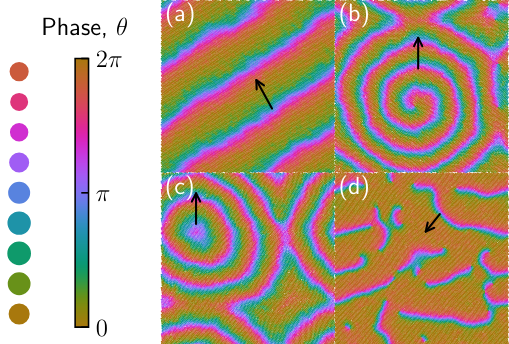
We reveal that the mechanical pulsation of locally synchronized particles is a generic route to propagate deformation waves. We consider a model of dense repulsive particles whose activity drives periodic change in size of each individual. The dynamics is inspired by biological tissues where cells consume fuel to sustain active deformation. We show that the competition between repulsion and synchronization triggers an instability which promotes a wealth of dynamical patterns, ranging from spiral waves to defect turbulence. We identify the mechanisms underlying the emergence of patterns, and characterize the corresponding transitions. By coarse-graining the dynamics, we propose a hydrodynamic description of an assembly of pulsating particles, and discuss an analogy with reaction-diffusion systems.
[1] Y. Zhang and É. Fodor, 'Pulsating active matter', Phys. Rev. Lett. 131, 238302 (2023).
[2] A. Manacorda and É. Fodor, 'Pulsating with discrete symmetry', arXiv:2310.14370
[3] W. D. Piñeros and É. Fodor, 'Biased ensembles of pulsating active matter', arXiv:2403.16961
[4] T. Banerjee, T. Desaleux, J. Ranft, and É. Fodor, 'Hydrodynamics of pulsating active liquids', arXiv:2407.19955
We investigate the information-theoretical limits of inference tasks in epidemic spreading on graphs, in the large-size limit. The typical inference tasks consist in computing observable of the posterior distribution of the epidemic model given observations taken from a ground truth (sometimes called planted) random trajectory. We give theoretical predictions on the posterior probability distribution of the trajectory of each individual, conditioned to observations on the state of individuals at given times, focusing on the Susceptible Infectious (SI) model.
In the Bayes-optimal condition, i.e. when true dynamic parameters are known, we provide predictions for the information theoretic limits of various inference tasks, in form of phase diagrams. We also identify a region, in the Bayes-Optimal setting, exhibiting a Replica Symmetry Breaking phase transition. When true parameters are unknown, we show how a maximum-likelihood procedure is able to recover them with mostly unaffected performance.
We introduce a Metropolis-Hastings Markov chain for Boltzmann distributions of classical spin systems. It relies on approximate tensor network contractions to propose correlated collective updates at each step of the evolution. We present benchmarks for a variety of instances of the two-dimensional Ising model, including ferromagnetic, antiferromagnetic, (fully) frustrated and Edwards-Anderson spin glass cases. With modest computational effort, our Markov chain achieves sizeable acceptance rates, even in the vicinity of critical points. It compares well with other Monte Carlo schemes such as the Metropolis or Wolff algorithm: equilibration times appear to be reduced by a factor that varies between 40 and 2000, depending on the model and the observable being monitored. The scheme can be adapted to three dimensions, matrix models, or a confined gas of hard spheres.
LAST-MODIFIED:20241010T150537Z SEQUENCE:2448787 X-ACCESS:1 X-HITS:656 X-COLOR:3366cc X-SHOW-END-TIME:1 END:VEVENT BEGIN:VEVENT DTSTART;TZID=Europe/Paris:20241001T124500 DTEND;TZID=Europe/Paris:20241001T134500 UID:CC7FE61A-D1CB-4F45-8697-AB2AC56DEC5A SUMMARY:Andrea Tononi (ICFO, Barcelona, Spain) CREATED:20240716T072855Z DTSTAMP:20240716T072855Z URL:https://www.lptmc.jussieu.fr/vie-scientifique/listeseminaires/andrea-tononi-icfo-barcelona-spain-2 DESCRIPTION:Temporal Bell inequalities in a many-body system\NWe formulate a temporal Clauser-Horne inequality by considering two parties choosing two observables to measure at different consecutive times. For two entangled antipodal spins joined by a spin chain, we show that the inequality is violated during a small finite time interval between the measurements. This fact contrasts with the time evolution in vacuum, which is describable in terms of a hidden-variable theory. Our result demonstrates that the finite velocity for quantum information spreading in the chain prevents signaling and therefore the immediate vanishing of quantumness.\NSlides (pdf) X-ALT-DESC;FMTTYPE=text/html:We formulate a temporal Clauser-Horne inequality by considering two parties choosing two observables to measure at different consecutive times. For two entangled antipodal spins joined by a spin chain, we show that the inequality is violated during a small finite time interval between the measurements. This fact contrasts with the time evolution in vacuum, which is describable in terms of a hidden-variable theory. Our result demonstrates that the finite velocity for quantum information spreading in the chain prevents signaling and therefore the immediate vanishing of quantumness.
LAST-MODIFIED:20241106T080445Z SEQUENCE:9765350 X-ACCESS:1 X-HITS:793 X-COLOR:3366cc X-SHOW-END-TIME:1 END:VEVENT BEGIN:VEVENT DTSTART;TZID=Europe/Paris:20241008T104500 DTEND;TZID=Europe/Paris:20241008T114500 UID:661FAD5B-61BA-48A1-942F-E869E60C8F71 SUMMARY:Kirone Mallick (IPhT, Saclay) CREATED:20240717T091050Z DTSTAMP:20240717T091050Z URL:https://www.lptmc.jussieu.fr/vie-scientifique/listeseminaires/kirone-mallick-ipht-saclay DESCRIPTION:Macroscopic fluctuations out of equilibrium\NA system, subject to continuous exchanges of matter, energy or information with its surroundings, may reach a non-equilibrium steady state in which various currents break time-reversal invariance and continuously generate entropy. Such a state can not be accounted for by the Principles of Thermodynamics or the Gibbs-Boltzmann laws of statistical physics. Besides, linear response theory and the Onsager-Machlup functional provide useful descriptions of large scale fluctuations in such driven systems only at first order, in the vicinity of equilibrium.\NIn the last two decades, important advances in our understanding of processes far from equilibrium have been achieved, for which rare events, large deviations and fluctuations relations provide a unified framework. The emergence of universal features can be studied thanks to a variational principle, proposed by G. Jona-Lasinio and his collaborators, known as the Macroscopic Fluctuation Theory (MFT). In this theory, optimal fluctuations far from equilibrium are determined at a coarse-grained scale by two coupled non-linear hydrodynamic equations. The objective of this talk is to present these concepts and to illustrate them with some exact solutions of the MFT equations.\NSlides (pdf) X-ALT-DESC;FMTTYPE=text/html:A system, subject to continuous exchanges of matter, energy or information with its surroundings, may reach a non-equilibrium steady state in which various currents break time-reversal invariance and continuously generate entropy. Such a state can not be accounted for by the Principles of Thermodynamics or the Gibbs-Boltzmann laws of statistical physics. Besides, linear response theory and the Onsager-Machlup functional provide useful descriptions of large scale fluctuations in such driven systems only at first order, in the vicinity of equilibrium.
In the last two decades, important advances in our understanding of processes far from equilibrium have been achieved, for which rare events, large deviations and fluctuations relations provide a unified framework. The emergence of universal features can be studied thanks to a variational principle, proposed by G. Jona-Lasinio and his collaborators, known as the Macroscopic Fluctuation Theory (MFT). In this theory, optimal fluctuations far from equilibrium are determined at a coarse-grained scale by two coupled non-linear hydrodynamic equations. The objective of this talk is to present these concepts and to illustrate them with some exact solutions of the MFT equations.
LAST-MODIFIED:20241106T075422Z SEQUENCE:9672212 X-ACCESS:1 X-HITS:1730 X-COLOR:3366cc X-SHOW-END-TIME:1 END:VEVENT BEGIN:VEVENT DTSTART;TZID=Europe/Paris:20241105T104500 DTEND;TZID=Europe/Paris:20241105T114500 UID:16B8FA57-9853-4D58-9BCC-9CC66106F78B SUMMARY:Gwendal Fève (LPENS, Sorbonne) CREATED:20241001T064729Z DTSTAMP:20241001T064729Z URL:https://www.lptmc.jussieu.fr/vie-scientifique/listeseminaires/gwendal-feve-lpens-sorbonne DESCRIPTION:Anyon braiding in mesoscopic colliders\NIn three-dimensional space, elementary particles are divided between fermions and bosons according to the properties of symmetry of the wave function describing the state of the system when two particles are exchanged. The situation is different in two-dimensional systems which can host exotic quasiparticles, called anyons, which obey intermediate quantum statistics characterized by an exchange phase varying between and [1,2]. As a consequence, contrary to fermions and bosons, anyons keep a robust memory of braiding operations, which consist in moving one anyon around another one.\NIn particular anyons have been predicted to the be the elementary excitations of the fractional quantum Hall regime, obtained by applying a strong magnetic field perpendicular to a two-dimensional conductor. I will discuss recent experiments realized in fractional quantum Hall conductors to demonstrate the fractional statistics of anyons [3, 5-6], focusing on the anyon collider geometry [7], where anyon braiding can be revealed by studying the partitioning of dilute anyon beams by a beam splitter.\N \NReferences:\N[1] B. I. Halperin, Phys. Rev. Lett. 52, 1583–1586 (1984).\N[2] D. Arovas, J. R. Schrieffer, F. Wilczek, Phys. Rev. Lett. 53, 722–723 (1984).\N[3] H. Bartolomei et al., Science 368, 173 (2020).\N[4] J. Nakamura S. Liang, G. C. Gardner, and M. J. Manfra, Nature Physics 16, 931 (2020).\N[5] M. Ruelle et al., Phys. Rev. X 13, 011031 (2023).\N[6] M. Ruelle et al., arXiv:2409.08685 (2024)\N[7] B. Rosenow, I. P. Levkivskyi, B. I. Halperin, Phys. Rev. Lett. 116, 156802 (2016).\N \NSlides (pdf)\N X-ALT-DESC;FMTTYPE=text/html:Quantum paramagnets represent intriguing quantum phases that evade ordering even at absolute zero temperature. While detecting their presence is relatively straightforward, unraveling their fundamental nature can be a challenging task. In this talk, I will present our recent work [1] on the Lieb-Schultz-Mattis (LSM) constraints which prohibit certain quantum paramagnets from being a “trivial” one. I will illustrate the use of these results through two examples: (1) the prediction of a Dirac spin liquid in the triangular lattice compound NaYbO2, and (2) the characterization of U(1) quantum spin liquids in a pyrochlore S=1/2 antiferromagnet. I will highlight the topological response theory underlying the LSM constraints that we developed, containing information about symmetry, excitations, and lattice defects, applicable to all 3D quantum paramagnets.
[1] Liu & Ye, arXiv:2410.03607
LAST-MODIFIED:20241119T162958Z SEQUENCE:2194403 X-ACCESS:1 X-HITS:860 X-COLOR:3366cc X-SHOW-END-TIME:1 END:VEVENT BEGIN:VEVENT DTSTART;TZID=Europe/Paris:20241121T140000 DTEND;TZID=Europe/Paris:20241121T150000 UID:268D0EC0-790F-4BFE-B700-A1CEA49E40AF SUMMARY:[Séminaire exceptionnel] Francesco Mori (Oxford, UK) CREATED:20241007T151010Z DTSTAMP:20241007T151010Z URL:https://www.lptmc.jussieu.fr/vie-scientifique/listeseminaires/seminaire-exceptionnel-francesco-mori-oxford-uk DESCRIPTION:Optimal strategies in navigation and learning: statistical physics meets control theory\NTo survive, animals must acquire a diverse set of skills and integrate them to respond effectively to complex environments. For instance, to move in a straight line in rough terrains, dung beetles alternate between egocentric strategies, maintaining an internal estimate of position, and geocentric strategies, using landmarks for trajectory correction. In the first part of this talk, I will consider this behaviour within a minimal model of navigation and derive the switching strategy that maximises speed, accounting for environmental, execution, and sensory noise. In the second part of the talk, I will consider the complementary problem of learning multiple skills/tasks, a.k.a., continual learning. While animals typically excel at continual learning, artificial neural networks often forget older tasks when new ones are introduced. By combining exact training dynamics from statistical physics with optimal control methods, I will derive strategies that optimise performance while avoiding forgetting. This flexible framework reveals interpretable strategies in multi-task learning and can be adapted to optimise high-dimensional learning processes.\N \NReferences: arXiv:2311.18813 and arXiv:2409.18061\N \NSlides (pdf)\N X-ALT-DESC;FMTTYPE=text/html:Soliton gases represent infinite random ensembles of interacting solitons displaying nontrivial large-scale behaviours governed by the properties of the elementary two-soliton collisions. The dynamics of non-equilibrium soliton gases in integrable dispersive systems such as the Korteweg-de Vries and nonlinear Schrödinger equations is described by a nonlinear integro-differential kinetic equation for the density of states in the spectral (Lax) phase space. In my talk, I will outline the main ideas of the kinetic theory of soliton gases and its application within the context of integrable turbulence for the Korteweg-de Vries equation.
LAST-MODIFIED:20241210T114341Z SEQUENCE:7240751 X-ACCESS:1 X-HITS:696 X-COLOR:3366cc X-SHOW-END-TIME:1 END:VEVENT BEGIN:VEVENT DTSTART;TZID=Europe/Paris:20241212T140000 DTEND;TZID=Europe/Paris:20241212T150000 UID:1C6DB4B2-2B4D-4753-8C44-BEDD8B6C96D9 SUMMARY:[Séminaire TQM] Vincent Renard CREATED:20240913T130507Z DTSTAMP:20240913T130507Z URL:https://www.lptmc.jussieu.fr/vie-scientifique/listeseminaires/vincent-renard LAST-MODIFIED:20241010T150059Z SEQUENCE:2339752 X-ACCESS:1 X-HITS:529 X-COLOR:1f7a00 X-SHOW-END-TIME:1 END:VEVENT BEGIN:VEVENT DTSTART;TZID=Europe/Paris:20241217T104500 DTEND;TZID=Europe/Paris:20241217T114500 UID:1D30D43E-6AE0-4C85-B021-E5B543529D5B SUMMARY:Guillaume Barraquand (ENS, Paris) CREATED:20240924T080630Z DTSTAMP:20240924T080630Z URL:https://www.lptmc.jussieu.fr/vie-scientifique/listeseminaires/guillaume-barraquand-ens-paris DESCRIPTION:Diffusion in random environment\NConsider a particle hopping on a one dimensional lattice. At each time step, the particle moves by +1 or -1 with probability p or 1-p. It is well known that the trajectory of such particle at large scale is a Brownian motion. What if the probabilities p=p_{x,t} depend on the position x and time t ? Say that the p_{x,t} are independent and uniformly distributed in [0,1]. Then, at large scale, the behaviour is still Brownian. However, the extreme behaviour of such particles radically differ from classical diffusion. The large deviations rather follow scales and statistics characteristic to the Kardar-Parisi-Zhang universality class. I will give a panorama of several results obtained in the last 10 years in this direction, in the mathematics and physics literature. X-ALT-DESC;FMTTYPE=text/html:Consider a particle hopping on a one dimensional lattice. At each time step, the particle moves by +1 or -1 with probability p or 1-p. It is well known that the trajectory of such particle at large scale is a Brownian motion. What if the probabilities p=p_{x,t} depend on the position x and time t ? Say that the p_{x,t} are independent and uniformly distributed in [0,1]. Then, at large scale, the behaviour is still Brownian. However, the extreme behaviour of such particles radically differ from classical diffusion. The large deviations rather follow scales and statistics characteristic to the Kardar-Parisi-Zhang universality class. I will give a panorama of several results obtained in the last 10 years in this direction, in the mathematics and physics literature.
LAST-MODIFIED:20241211T121035Z SEQUENCE:6753845 X-ACCESS:1 X-HITS:709 X-COLOR:3366cc X-SHOW-END-TIME:1 END:VEVENT BEGIN:VEVENT DTSTART;TZID=Europe/Paris:20250114T104500 DTEND;TZID=Europe/Paris:20250114T114500 UID:6BE01CE8-DC2E-4982-B46D-178CAF32EEF7 SUMMARY:Nicolas Pavloff (LPTMS) CREATED:20241118T145620Z DTSTAMP:20241118T145620Z URL:https://www.lptmc.jussieu.fr/vie-scientifique/listeseminaires/nicolas-pavloff-lptms DESCRIPTION:Topological Pathways to Two-Dimensional Quantum Turbulence\NI shall present a combined experimental and theoretical investigation of the formation and decay kinetics of vortices in a two-dimensional turbulent superfluid. Fundamental topological conservation laws require that the formation and annihilation of vortices also involve critical points of the velocity field, namely nodes and saddles. Identifying the simplest bifurcations underlying these processes enables to develop an effective kinetic model that closely aligns with experimental observations, and shows that different mechanisms are responsible for vortex number growth and decay.\NSlides (pdf) X-ALT-DESC;FMTTYPE=text/html:I shall present a combined experimental and theoretical investigation of the formation and decay kinetics of vortices in a two-dimensional turbulent superfluid. Fundamental topological conservation laws require that the formation and annihilation of vortices also involve critical points of the velocity field, namely nodes and saddles. Identifying the simplest bifurcations underlying these processes enables to develop an effective kinetic model that closely aligns with experimental observations, and shows that different mechanisms are responsible for vortex number growth and decay.
LAST-MODIFIED:20250115T101131Z SEQUENCE:4994111 X-ACCESS:1 X-HITS:1014 X-COLOR:3366cc X-SHOW-END-TIME:1 END:VEVENT BEGIN:VEVENT DTSTART;TZID=Europe/Paris:20250116T140000 DTEND;TZID=Europe/Paris:20250116T150000 UID:411DB1A1-771A-4721-A5F3-8AA31E2B08A8 SUMMARY:[Séminaire TQM] Ben Wieder (IPhT) CREATED:20241216T134637Z DTSTAMP:20241216T134637Z URL:https://www.lptmc.jussieu.fr/vie-scientifique/listeseminaires/ben-wieder-ipht DESCRIPTION:Monopole Quantum Numbers and Projective Representations in Stable and Fragile Topological Crystalline Insulators\NOver the past 15 years, a dizzying array of noninteracting topological insulator (TI) and topological crystalline insulator (TCI) phases have been theoretically predicted and identified in real materials. While the TI states are well understood, the TCI states – which comprise the majority of topological materials in nature – exhibit more complicated classification groups and boundary states and carry more ambiguous response signatures. For earlier variants of interacting symmetry-protected topological states (SPTs), both the classification and response were clarified through the many-body quantum numbers of the 0D collective excitations bound to crystal and electromagnetic defects, such as magnetic fluxes and monopoles. In particular, when 0D defects exhibit fractionalized quantum numbers, or more generally projective representations of the local many-body symmetry group, this can indicate the presence of quantized responses in the bulk that are governed by long-wavelength topological field theories that are stable to symmetric interactions. In this talk, I will introduce numerical methods for computing defect quantum numbers in stable and fragile TCI states via the reduced density matrix, revealing a deep connection between defect quantum numbers and the entanglement spectrum. Surprisingly, we find that when crystal symmetries are included in the local symmetry group, defects can appear to transform projectively even in Wannierizable (fragile) insulators, casting doubt on the suitability of magnetic monopoles for characterizing the TCI states present in real 3D materials. Our results represent a crucial step towards describing TCIs beyond tight-binding models and frameworks like “higher-order topology,” and facilitate more direct connections between free-fermion TCIs and interacting SPTs. X-ALT-DESC;FMTTYPE=text/html:Monopole Quantum Numbers and Projective Representations in Stable and Fragile Topological Crystalline Insulators
Over the past 15 years, a dizzying array of noninteracting topological insulator (TI) and topological crystalline insulator (TCI) phases have been theoretically predicted and identified in real materials. While the TI states are well understood, the TCI states – which comprise the majority of topological materials in nature – exhibit more complicated classification groups and boundary states and carry more ambiguous response signatures. For earlier variants of interacting symmetry-protected topological states (SPTs), both the classification and response were clarified through the many-body quantum numbers of the 0D collective excitations bound to crystal and electromagnetic defects, such as magnetic fluxes and monopoles. In particular, when 0D defects exhibit fractionalized quantum numbers, or more generally projective representations of the local many-body symmetry group, this can indicate the presence of quantized responses in the bulk that are governed by long-wavelength topological field theories that are stable to symmetric interactions. In this talk, I will introduce numerical methods for computing defect quantum numbers in stable and fragile TCI states via the reduced density matrix, revealing a deep connection between defect quantum numbers and the entanglement spectrum. Surprisingly, we find that when crystal symmetries are included in the local symmetry group, defects can appear to transform projectively even in Wannierizable (fragile) insulators, casting doubt on the suitability of magnetic monopoles for characterizing the TCI states present in real 3D materials. Our results represent a crucial step towards describing TCIs beyond tight-binding models and frameworks like “higher-order topology,” and facilitate more direct connections between free-fermion TCIs and interacting SPTs.
LAST-MODIFIED:20250113T150401Z SEQUENCE:2423844 X-ACCESS:1 X-HITS:654 X-COLOR:1f7a00 X-SHOW-END-TIME:1 END:VEVENT BEGIN:VEVENT DTSTART;TZID=Europe/Paris:20250121T104500 DTEND;TZID=Europe/Paris:20250121T114500 UID:B0346950-42B4-428F-8F05-98770F8D1A05 SUMMARY:Michel Fruchart (Gulliver, ESPCI) CREATED:20241204T123201Z DTSTAMP:20241204T123201Z URL:https://www.lptmc.jussieu.fr/vie-scientifique/listeseminaires/michel-fruchart-gulliver-espci DESCRIPTION:Pattern formation by turbulent cascades\NFully developed turbulence is a universal and scale-invariant chaotic state characterized by an energy cascade from large to small scales at which the cascade is eventually arrested by dissipation. Here we show how to harness these seemingly structureless turbulent cascades to generate patterns. Pattern formation entails a process of wavelength selection, which can usually be traced to the linear instability of a homogeneous state. By contrast, the mechanism we propose here is fully nonlinear. It is triggered by the non-dissipative arrest of turbulent cascades: energy piles up at an intermediate scale, which is neither the system size nor the smallest scales at which energy is usually dissipated. Using a combination of theory and large-scale simulations, we show that the tunable wavelength of these cascade-induced patterns can be set by a non-dissipative transport coefficient called odd viscosity, ubiquitous in chiral fluids ranging from bioactive to quantum systems. Odd viscosity, which acts as a scale-dependent Coriolis-like force, leads to a two-dimensionalization of the flow at small scales, in contrast with rotating fluids in which a two-dimensionalization occurs at large scales. Apart from odd viscosity fluids, we discuss how cascade-induced patterns can arise in natural systems, including atmospheric flows, stellar plasma such as the solar wind, or the pulverization and coagulation of objects or droplets in which mass rather than energy cascades. X-ALT-DESC;FMTTYPE=text/html:Fully developed turbulence is a universal and scale-invariant chaotic state characterized by an energy cascade from large to small scales at which the cascade is eventually arrested by dissipation. Here we show how to harness these seemingly structureless turbulent cascades to generate patterns. Pattern formation entails a process of wavelength selection, which can usually be traced to the linear instability of a homogeneous state. By contrast, the mechanism we propose here is fully nonlinear. It is triggered by the non-dissipative arrest of turbulent cascades: energy piles up at an intermediate scale, which is neither the system size nor the smallest scales at which energy is usually dissipated. Using a combination of theory and large-scale simulations, we show that the tunable wavelength of these cascade-induced patterns can be set by a non-dissipative transport coefficient called odd viscosity, ubiquitous in chiral fluids ranging from bioactive to quantum systems. Odd viscosity, which acts as a scale-dependent Coriolis-like force, leads to a two-dimensionalization of the flow at small scales, in contrast with rotating fluids in which a two-dimensionalization occurs at large scales. Apart from odd viscosity fluids, we discuss how cascade-induced patterns can arise in natural systems, including atmospheric flows, stellar plasma such as the solar wind, or the pulverization and coagulation of objects or droplets in which mass rather than energy cascades.
LAST-MODIFIED:20250109T075856Z SEQUENCE:3094015 X-ACCESS:1 X-HITS:859 X-COLOR:3366cc X-SHOW-END-TIME:1 END:VEVENT BEGIN:VEVENT DTSTART;TZID=Europe/Paris:20250128T104500 DTEND;TZID=Europe/Paris:20250128T114500 UID:C1D7D46B-58B6-4686-B709-6451CC28F3C7 SUMMARY:Léo Mangeolle (TUM, Munich) CREATED:20241213T123110Z DTSTAMP:20241213T123110Z URL:https://www.lptmc.jussieu.fr/vie-scientifique/listeseminaires/leo-mangeolle-tum-munich DESCRIPTION:Thermal Hall conductivity of neutral bosons from the quantum kinetic equation\NThermal Hall conductivity has recently emerged as an experimentally accessible property of insulating materials. Theoretical understanding thereof has remained a challenge, in particular since the breaking of time-reversal symmetry by neutral particles is nontrivial and can emerge from multiple mechanisms (semiclassical dynamics, skew-scattering, etc). In a first part, I will present a general formulation of inelastic skew-scattering of energy-carrying bosons by other collective excitations. Specializing to phonon-magnon interactions, I will show that a phonon thermal Hall effect from skew-scattering in antiferromagnets is allowed by magnetoelastic and spin-orbit couplings. In a second part, I will focus on the free semiclassical dynamics of neutral bosons, and present a systematic derivation of their kinetic equation, incorporating the topological dynamics of wavepackets in the form of Berry curvatures (generalized to phase space). This makes it possible to treat inhomogeneous systems, including boundaries, textures, etc., in a compact and natural manner. X-ALT-DESC;FMTTYPE=text/html:Thermal Hall conductivity has recently emerged as an experimentally accessible property of insulating materials. Theoretical understanding thereof has remained a challenge, in particular since the breaking of time-reversal symmetry by neutral particles is nontrivial and can emerge from multiple mechanisms (semiclassical dynamics, skew-scattering, etc). In a first part, I will present a general formulation of inelastic skew-scattering of energy-carrying bosons by other collective excitations. Specializing to phonon-magnon interactions, I will show that a phonon thermal Hall effect from skew-scattering in antiferromagnets is allowed by magnetoelastic and spin-orbit couplings. In a second part, I will focus on the free semiclassical dynamics of neutral bosons, and present a systematic derivation of their kinetic equation, incorporating the topological dynamics of wavepackets in the form of Berry curvatures (generalized to phase space). This makes it possible to treat inhomogeneous systems, including boundaries, textures, etc., in a compact and natural manner.
LAST-MODIFIED:20250114T123412Z SEQUENCE:2764982 X-ACCESS:1 X-HITS:1068 X-COLOR:3366cc X-SHOW-END-TIME:1 END:VEVENT BEGIN:VEVENT DTSTART;TZID=Europe/Paris:20250204T104500 DTEND;TZID=Europe/Paris:20250204T114500 UID:6FFA1C3D-3B31-405C-959E-1BEC45F7A529 SUMMARY:Nina Javerzat (LIPhy) & Enrico Ventura (Milan) CREATED:20250108T160806Z DTSTAMP:20250108T160806Z URL:https://www.lptmc.jussieu.fr/vie-scientifique/listeseminaires/nina-javerzat-liphy-enrico-ventura-milan DESCRIPTION:Nina Javerzat : Conformal Invariance of Rigidity Percolation\NRigidity Percolation (RP) attracted much attention in soft matter, as an elegant framework to understand the non-trivial emergence of solidity, in media that not present any long-range structural order. The solidification of amorphous systems like gels, fiber networks or living tissues can indeed be understood by focusing on locally rigid structures --clusters, that grow and coalesce until one eventually percolates the whole system, ensuring macroscopic mechanical stability. As a statistical model, Rigidity Percolation is defined from the concept of graph rigidity. I will explain that RP possesses a unique non-local character, leading to a rich behaviour that is absent in the usual Connectivity Percolation problem.\NInspired by the great success of conformal field theory to understand critical phenomena, I have recently examined conformal invariance in 2D Rigidity Percolation. I will present two works where I gave numerical evidence of conformal invariance: i) from properties of the so-called connectivity functions, and ii) from consistence of the boundaries of clusters with Schramm-Loewner Evolution processes. These works reveal furthermore unexpected similarities with Connectivity Percolation, and allow to obtain a new relation between two of the critical exponents of RP.A lot remains to be understood about Rigidity Percolation, and I will end with my favourite perspectives.\NBased on Phys. Rev. Lett. 130, 268201 (2023) and Phys. Rev. Lett. 132, 018201(2024)\NSlides (pdf)\NEnrico Ventura : Memorization as Generalization in Physics-inspired Generative Models\NOur daily experience proves that humans are able to acquire and manipulate the hidden structure of the surrounding environment to generate creative ideas and survive. Artificial machines are also able to learn the unknown distribution of a set of data-points and use it to generate new examples. This capability, known under the name of generalization, is usually opposed to learning specific point-wise examples from the training-set. This second ability is called memorization. In this talk I will report some recent results supporting the picture of generalization as a “thermal” version of memorization with respect to a fictitious learning temperature. Both biologically-inspired (i.e spin-glass like neural networks) and artificial learning systems (i.e. diffusion models) will be analyzed under the lens of statistical mechanics.\NSlides (pdf) X-ALT-DESC;FMTTYPE=text/html:Rigidity Percolation (RP) attracted much attention in soft matter, as an elegant framework to understand the non-trivial emergence of solidity, in media that not present any long-range structural order. The solidification of amorphous systems like gels, fiber networks or living tissues can indeed be understood by focusing on locally rigid structures --clusters, that grow and coalesce until one eventually percolates the whole system, ensuring macroscopic mechanical stability. As a statistical model, Rigidity Percolation is defined from the concept of graph rigidity. I will explain that RP possesses a unique non-local character, leading to a rich behaviour that is absent in the usual Connectivity Percolation problem.
Inspired by the great success of conformal field theory to understand critical phenomena, I have recently examined conformal invariance in 2D Rigidity Percolation. I will present two works where I gave numerical evidence of conformal invariance: i) from properties of the so-called connectivity functions, and ii) from consistence of the boundaries of clusters with Schramm-Loewner Evolution processes. These works reveal furthermore unexpected similarities with Connectivity Percolation, and allow to obtain a new relation between two of the critical exponents of RP.
A lot remains to be understood about Rigidity Percolation, and I will end with my favourite perspectives.
Based on Phys. Rev. Lett. 130, 268201 (2023) and Phys. Rev. Lett. 132, 018201(2024)
Our daily experience proves that humans are able to acquire and manipulate the hidden structure of the surrounding environment to generate creative ideas and survive. Artificial machines are also able to learn the unknown distribution of a set of data-points and use it to generate new examples. This capability, known under the name of generalization, is usually opposed to learning specific point-wise examples from the training-set. This second ability is called memorization. In this talk I will report some recent results supporting the picture of generalization as a “thermal” version of memorization with respect to a fictitious learning temperature. Both biologically-inspired (i.e spin-glass like neural networks) and artificial learning systems (i.e. diffusion models) will be analyzed under the lens of statistical mechanics.
LAST-MODIFIED:20250212T081113Z SEQUENCE:2995387 X-ACCESS:1 X-HITS:1029 X-COLOR:3366cc X-SHOW-END-TIME:1 END:VEVENT BEGIN:VEVENT DTSTART;TZID=Europe/Paris:20250206T140000 DTEND;TZID=Europe/Paris:20250206T150000 UID:F310CF16-9671-4B9D-8012-F6702A983651 SUMMARY:[Séminaire TQM] Luca de Medici (LPEM, ESPCI) CREATED:20241217T134102Z DTSTAMP:20241217T134102Z URL:https://www.lptmc.jussieu.fr/vie-scientifique/listeseminaires/seminaire-tqm-luca-de-medici-lpem-espci DESCRIPTION:Luca de’ Medici (ESPCI, Paris)\NInsight into Hund metals and interplay with Mott physics\NHund metals are paramagnetic phases in which high-spin local configurations dominate. This paradigm is now a useful guidance to interpret the physics of many transition-metal compounds, like Ruthenates and Iron-based superconductors. I will show how this physics is extremized by moving towards a half-filled Mott insulator, and that it gives rise to charge instabilities and heavy fermionic behavior along the way.\NA. Georges and G. Kotliar, Physics Today 77, 46 (2024)\NM. Chatzieleftheriou et al. Phys. Rev. Lett. 130, 066401 (2023)\NM. Crispino et al. ArXiv:2312.06511 (2023) X-ALT-DESC;FMTTYPE=text/html:Luca de’ Medici (ESPCI, Paris)
Insight into Hund metals and interplay with Mott physics
Hund metals are paramagnetic phases in which high-spin local configurations dominate. This paradigm is now a useful guidance to interpret the physics of many transition-metal compounds, like Ruthenates and Iron-based superconductors. I will show how this physics is extremized by moving towards a half-filled Mott insulator, and that it gives rise to charge instabilities and heavy fermionic behavior along the way.
A. Georges and G. Kotliar, Physics Today 77, 46 (2024)
M. Chatzieleftheriou et al. Phys. Rev. Lett. 130, 066401 (2023)
M. Crispino et al. ArXiv:2312.06511 (2023)
LAST-MODIFIED:20250204T082218Z SEQUENCE:4214476 X-ACCESS:1 X-HITS:783 X-COLOR:1f7a00 X-SHOW-END-TIME:1 END:VEVENT BEGIN:VEVENT DTSTART;TZID=Europe/Paris:20250211T104500 DTEND;TZID=Europe/Paris:20250211T114500 UID:088C3852-E438-46D4-A0E5-BA41661F2CDC SUMMARY:Matias Gonzalez (Berlin) & Ruben Zakine (LadHyX) CREATED:20250203T082344Z DTSTAMP:20250203T082344Z URL:https://www.lptmc.jussieu.fr/vie-scientifique/listeseminaires/matias-gonzalez-berlin-ruben-zakine-ladhyx DESCRIPTION:Matias Gonzalez : Spiral spin liquids and surrounding phases in the square lattice XY model\NSpiral spin liquids possess a subextensively degenerate ground-state manifold, represented by a continuum of energy minima in reciprocal space. Since a small change of the spiral state wave vector requires a global change of the spin configuration in real space, it is a priori unclear how such systems can fluctuate within the degenerate ground-state manifold. Only recently it was proposed that momentum vortices are responsible for the liquidity of the spiral phase and that these systems are closely related to an emergent rank-2 U(1) gauge theory. As a consequence of this gauge structure, fourfold pinch-point singularities were found in a generalized spin correlator. In this paper, we use classical Monte Carlo and molecular dynamics calculations to embed the previously studied spiral spin liquid into a broader phase diagram of the square lattice XY model. We find a multitude of unusual phases and phase transitions surrounding the spiral spin liquid such as an effective four-state Potts transition into a collinear double-striped phase resulting from the spontaneous breaking of two coupled Z2 symmetries. Since this phase is stabilized by entropic effects selecting the momenta away from the spiral manifold, it undergoes a second phase transition at low temperatures into a nematic spiral phase which only breaks one Z2 symmetry. We also observe a region of parameters where the phase transition into the spiral spin liquid does not break any symmetries and where the critical exponents do not match those of standard universality classes. We study the importance of momentum vortices in driving this phase transition and discuss the possibility of a Kosterlitz-Thouless transition of momentum vortices. Finally, we explore the regime where the rank-2 U(1) gauge theory is valid by investigating the fourfold pinch-point singularities across the phase diagram.\N \NReferences:- H. Yan and J. Reuther, Phys. Rev. Research 4, 023175 (2022)- M. G. Gonzalez, A. Fancelli, H. Yan, and J. Reuther, Phys. Rev. B 110, 085106 (2024)\NRuben Zakine : Patterns robust to Disorder in spatially-interacting Generalized Lotka-Volterra Ecosystems\NHow do interactions between species influence their spatial distribution in an ecosystem? In this seminar, I will introduce a spatially-extended ecosystem of N interacting species (N large), where species can diffuse and interactions are nonlocal. I will compute the criterion for the loss of stability of the spatially homogeneous ecosystem, and I will show that the stability of the uniform state crucially depends on the most abundant species, and on the interplay between space exploration during one species generation and the interaction range. Focusing on the spectrum of the interaction matrix weighted by the species abundances, we identify a second order transition (of BBP type) that translates into a transition in the final patterns of the species repartition. Assuming that the disorder is small, we exhibit an explicit solution of the dynamical mean-field equation for the species density, obtained as the fixed point of a nonlocal Fisher-Kolmogorov-Petrovski-Piskounov equation. This work paves the way for future combined approaches at the frontier of active matter and disordered systems, with the hope of better understanding complex ecosystems like bacterial communities. X-ALT-DESC;FMTTYPE=text/html:How do interactions between species influence their spatial distribution in an ecosystem? In this seminar, I will introduce a spatially-extended ecosystem of N interacting species (N large), where species can diffuse and interactions are nonlocal. I will compute the criterion for the loss of stability of the spatially homogeneous ecosystem, and I will show that the stability of the uniform state crucially depends on the most abundant species, and on the interplay between space exploration during one species generation and the interaction range. Focusing on the spectrum of the interaction matrix weighted by the species abundances, we identify a second order transition (of BBP type) that translates into a transition in the final patterns of the species repartition. Assuming that the disorder is small, we exhibit an explicit solution of the dynamical mean-field equation for the species density, obtained as the fixed point of a nonlocal Fisher-Kolmogorov-Petrovski-Piskounov equation. This work paves the way for future combined approaches at the frontier of active matter and disordered systems, with the hope of better understanding complex ecosystems like bacterial communities.
LAST-MODIFIED:20250204T124152Z SEQUENCE:101888 X-ACCESS:1 X-HITS:596 X-COLOR:3366cc X-SHOW-END-TIME:1 END:VEVENT BEGIN:VEVENT DTSTART;TZID=Europe/Paris:20250213T140000 DTEND;TZID=Europe/Paris:20250213T150000 UID:CE29AE90-36C9-417D-99BC-FD5A65695061 SUMMARY:Nicolas Regnault (LPENS, Paris) CREATED:20241217T134153Z DTSTAMP:20241217T134153Z URL:https://www.lptmc.jussieu.fr/vie-scientifique/listeseminaires/nicolas-regnault-lpens-paris DESCRIPTION:Nicolas Regnault (Flatiron institute, NY et LPENS Paris)\NEngineering quantum phases of matter through moire materials: The case of Fractional Chern insulators\NProgress in stacking two dimensional materials, such as graphene or transition metal dichalcogenides (TMDs), has paved the way to engineer new structures relying on moire patterns. These patterns induced for example by slightly twisting one layer compared to the other, could lead to strongly correlated quantum phases such as superconductivity or the quantum anomalous Hall effects. In the realm of condensed matter physics, the fractional quantum Hall effect stands as a singular experimental manifestation of topological order, characterized by the presence of anyons—quasiparticles that bear fractional charge and exhibit exchange statistics diverging from conventional fermions and bosons. This phenomenon, observed over four decades ago, was still missing the direct observation of similar topological orders arising purely from band structure—without the application of strong magnetic fields. In 2023 within the span of a few months, several pioneering experiments have illuminated this once theoretical domain. Studies on twisted homobilayer MoTe2 and pentalayer rhombohedral graphene placed on hBN have finally unveiled the existence of fractional Chern insulators (FCIs), the zero-magnetic field analog of fractional quantum Hall states.\NThe journey to this point, preceded by over a decade of theoretical frameworks and predictions surrounding FCIs, yet the experimental revelations have proved to be richer and more surprising than expected. In this talk, we will present how the combination of ab-initio and quantum many-body calculations can help us capture the different features observed in experiments. We will discuss the potential future for this exciting booming field, including the possible observation of fractional topological insulators, a yet-never observed topological ordered phase preserving the time reversal symmetry. X-ALT-DESC;FMTTYPE=text/html:Nicolas Regnault (Flatiron institute, NY et LPENS Paris)
Engineering quantum phases of matter through moire materials: The case of Fractional Chern insulators
Progress in stacking two dimensional materials, such as graphene or transition metal dichalcogenides (TMDs), has paved the way to engineer new structures relying on moire patterns. These patterns induced for example by slightly twisting one layer compared to the other, could lead to strongly correlated quantum phases such as superconductivity or the quantum anomalous Hall effects. In the realm of condensed matter physics, the fractional quantum Hall effect stands as a singular experimental manifestation of topological order, characterized by the presence of anyons—quasiparticles that bear fractional charge and exhibit exchange statistics diverging from conventional fermions and bosons. This phenomenon, observed over four decades ago, was still missing the direct observation of similar topological orders arising purely from band structure—without the application of strong magnetic fields. In 2023 within the span of a few months, several pioneering experiments have illuminated this once theoretical domain. Studies on twisted homobilayer MoTe2 and pentalayer rhombohedral graphene placed on hBN have finally unveiled the existence of fractional Chern insulators (FCIs), the zero-magnetic field analog of fractional quantum Hall states.
The journey to this point, preceded by over a decade of theoretical frameworks and predictions surrounding FCIs, yet the experimental revelations have proved to be richer and more surprising than expected. In this talk, we will present how the combination of ab-initio and quantum many-body calculations can help us capture the different features observed in experiments. We will discuss the potential future for this exciting booming field, including the possible observation of fractional topological insulators, a yet-never observed topological ordered phase preserving the time reversal symmetry.
LAST-MODIFIED:20250204T082139Z SEQUENCE:4214386 X-ACCESS:1 X-HITS:845 X-COLOR:1f7a00 X-SHOW-END-TIME:1 END:VEVENT BEGIN:VEVENT DTSTART;TZID=Europe/Paris:20250218T104500 DTEND;TZID=Europe/Paris:20250218T114500 UID:5061D003-9CC0-4B3E-9807-38DBD086FAB6 SUMMARY:Thibault Bonnemain (PhLAM, Lille) & Simon Metayer (Shanghai) CREATED:20250108T161806Z DTSTAMP:20250108T161806Z URL:https://www.lptmc.jussieu.fr/vie-scientifique/listeseminaires/thibault-bonnemain-phlam-lille-simon-metayer-shanghai DESCRIPTION:Salle 523, couloir 12-13, 5è étage\NThibault Bonnemain : Generalised Hydrodynamics of the KdV Soliton Gas\NGeneralised Hydrodynamics (GHD) is a rather recent theory that provides a framework for studying a wide family of many-body integrable and nearly integrable systems out of equilibrium. I will introduce the notion of soliton gas, associated with the Korteweg-de Vries (KdV) equation among others, and use it as a paradigmatic example for the GHD of integrable, classical field theories. In particular, by way of a heuristic argument based on the analogy between solitons and classical particles, I will construct the thermodynamics of the KdV soliton gas (free energy, entropy, static covariance...), as well as the Euler-scale hydrodynamic equations describing the evolution of weakly inhomogeneous gases. The results thus produced agree with numerical simulations; moreover they are consistent with and supplement the more rigorous, albeit less transparent, construction pioneered by Gennady El, based on the so-called thermodynamic spectral limit of finite-gap solutions\NSlides (pdf)\NSimon Metayer : Precision Field Theory Applied to Statistical Physics Systems\NI present an overview of my recent results in higher-order analytical computations of renormalization group observables in interacting field theories relevant to condensed matter many-body systems. Extending beyond leading-order approximations is often challenging but crucial. It enhances theoretical precision, provides benchmarks for less controlled methods, and, more interestingly, can unveil new physical phenomena. I will illustrate these points through concrete examples from my recent works. For clean polymerized membranes, cutting-edge four-loop calculation yield unprecedented precision for the anomalous elasticity exponent, thanks to surprisingly well-behaved epsilon expansions. These results benchmark precisely NPRG and SCSA methods and align closely with simulations and experiments on various membranes. Generalizing to the quenched disordered case, three-loop corrections reveal a previously unseen disorder-induced wrinkling transition towards a glassy phase fixed point, observed in partial polymerization experiments. In three-dimensional QED, higher-order large-N corrections refine the optical conductivity of graphene, while solving self-consistently the Schwinger-Dyson equations truncated beyond leading order sheds new light on fermion mass generation and interaction-driven metal-insulator transitions in graphene-like systems. In a minimal supersymmetric extension, higher-order large-N estimates predict the optical properties of "supergraphene" and uncover the previously unseen impact of supersymmetry in preventing dynamical symmetry breaking, making supergraphene a permanent conductor. These results demonstrate how precision calculations in field theory still remain a powerful framework for understanding and unveiling new emergent phenomena in complex statistical and quantum physics systems. \NSlides (pdf) X-ALT-DESC;FMTTYPE=text/html:Salle 523, couloir 12-13, 5è étage
Generalised Hydrodynamics (GHD) is a rather recent theory that provides a framework for studying a wide family of many-body integrable and nearly integrable systems out of equilibrium. I will introduce the notion of soliton gas, associated with the Korteweg-de Vries (KdV) equation among others, and use it as a paradigmatic example for the GHD of integrable, classical field theories. In particular, by way of a heuristic argument based on the analogy between solitons and classical particles, I will construct the thermodynamics of the KdV soliton gas (free energy, entropy, static covariance...), as well as the Euler-scale hydrodynamic equations describing the evolution of weakly inhomogeneous gases. The results thus produced agree with numerical simulations; moreover they are consistent with and supplement the more rigorous, albeit less transparent, construction pioneered by Gennady El, based on the so-called thermodynamic spectral limit of finite-gap solutions
I present an overview of my recent results in higher-order analytical computations of renormalization group observables in interacting field theories relevant to condensed matter many-body systems. Extending beyond leading-order approximations is often challenging but crucial. It enhances theoretical precision, provides benchmarks for less controlled methods, and, more interestingly, can unveil new physical phenomena. I will illustrate these points through concrete examples from my recent works. For clean polymerized membranes, cutting-edge four-loop calculation yield unprecedented precision for the anomalous elasticity exponent, thanks to surprisingly well-behaved epsilon expansions. These results benchmark precisely NPRG and SCSA methods and align closely with simulations and experiments on various membranes. Generalizing to the quenched disordered case, three-loop corrections reveal a previously unseen disorder-induced wrinkling transition towards a glassy phase fixed point, observed in partial polymerization experiments. In three-dimensional QED, higher-order large-N corrections refine the optical conductivity of graphene, while solving self-consistently the Schwinger-Dyson equations truncated beyond leading order sheds new light on fermion mass generation and interaction-driven metal-insulator transitions in graphene-like systems. In a minimal supersymmetric extension, higher-order large-N estimates predict the optical properties of "supergraphene" and uncover the previously unseen impact of supersymmetry in preventing dynamical symmetry breaking, making supergraphene a permanent conductor. These results demonstrate how precision calculations in field theory still remain a powerful framework for understanding and unveiling new emergent phenomena in complex statistical and quantum physics systems.
LAST-MODIFIED:20250220T124532Z SEQUENCE:3702446 X-ACCESS:1 X-HITS:725 X-COLOR:3366cc X-SHOW-END-TIME:1 END:VEVENT BEGIN:VEVENT DTSTART;TZID=Europe/Paris:20250304T104500 DTEND;TZID=Europe/Paris:20250304T114500 UID:9CC5CE50-D933-4C79-8F3D-05DFC8E788AE SUMMARY:Urko Reinosa (CPhT, Polytechnique) CREATED:20241118T093054Z DTSTAMP:20241118T093054Z URL:https://www.lptmc.jussieu.fr/vie-scientifique/listeseminaires/urko-reinosa-polytechnique DESCRIPTION:Salle 523, couloir 12-13, 5è étage\NA new paradigm for Quantum Chromodynamics in the infrared?\NThe strong interaction is one of the fundamental forces in Nature, responsible in particular for binding together protons and neutrons inside nuclei, despite the repulsive electromagnetic forces between the positively charged protons. Our current understanding of this interaction relies on Quantum Chromodynamics (QCD) which describes it as an interaction between elementary particles known as quarks, carriers of a new type of charge dubbed as color. The interaction occurs via the exchange of quanta of a gauge field, the gluon field, in a way similar to the exchange of photons between electrons in Quantum Electrodynamics (QED).\NDespite this satisfying similarity with QED, the two theories are not alike. In particular, the gluons themselves carry color and hence self-interact, unlike the photons in QED. In addition, quarks are never observed under normal, low energy (infrared) conditions. They are rather confined inside hadrons of which the protons and the nucleons are just a few representatives. In addition, the masses of the hadrons are way larger than the masses of their constituent quarks, thus hinting at an enormous binding energy in those systems.\NUnderstanding these properties of the strong interaction from QCD is a notoriously difficult task due to the size of the interaction strength in the infrared. This has instigated the development of non-perturbative approaches based either on the Monte-Carlo evaluation of the QCD partition function on a discrete lattice, or on its continuum reformulation in terms of infinite hierarchies of equations for QCD correlation functions. Lattice QCD provides an almost exact description of QCD that can however not be used in all situations. As for continuum approaches, even though they can be extended to these situations in principle, they very often rely on uncontrolled truncations that prevent a quantitative estimate of the error.\NOver the last decades, however, the lattice simulation of QCD correlators in the Landau gauge has revealed unexpected features that shed some light on how the various QCD fields are coupled at low energies. This allows one to contemplate a "third way" into infrared QCD. In this talk, I review a ten year effort (in collaboration with Julien Serreau (APC) and Matthieu Tissier (LPTMC) in France, as well as Nicolás Wschebor and Marcela Peláez in Uruguay) to put these ideas into solid ground, using the Curci-Ferrari action, a one-parameter model for Landau gauge-fixed QCD in the infrared. In particular, I will discuss how this approach allows one to retrieve the lattice results for the QCD correlation functions and to investigate features of the phase diagram that relate to the most fundamental properties of QCD such as confinement or dynamical mass generation.\NSlides (pdf) X-ALT-DESC;FMTTYPE=text/html:Salle 523, couloir 12-13, 5è étage
The strong interaction is one of the fundamental forces in Nature, responsible in particular for binding together protons and neutrons inside nuclei, despite the repulsive electromagnetic forces between the positively charged protons. Our current understanding of this interaction relies on Quantum Chromodynamics (QCD) which describes it as an interaction between elementary particles known as quarks, carriers of a new type of charge dubbed as color. The interaction occurs via the exchange of quanta of a gauge field, the gluon field, in a way similar to the exchange of photons between electrons in Quantum Electrodynamics (QED).
Despite this satisfying similarity with QED, the two theories are not alike. In particular, the gluons themselves carry color and hence self-interact, unlike the photons in QED. In addition, quarks are never observed under normal, low energy (infrared) conditions. They are rather confined inside hadrons of which the protons and the nucleons are just a few representatives. In addition, the masses of the hadrons are way larger than the masses of their constituent quarks, thus hinting at an enormous binding energy in those systems.
Understanding these properties of the strong interaction from QCD is a notoriously difficult task due to the size of the interaction strength in the infrared. This has instigated the development of non-perturbative approaches based either on the Monte-Carlo evaluation of the QCD partition function on a discrete lattice, or on its continuum reformulation in terms of infinite hierarchies of equations for QCD correlation functions. Lattice QCD provides an almost exact description of QCD that can however not be used in all situations. As for continuum approaches, even though they can be extended to these situations in principle, they very often rely on uncontrolled truncations that prevent a quantitative estimate of the error.
Over the last decades, however, the lattice simulation of QCD correlators in the Landau gauge has revealed unexpected features that shed some light on how the various QCD fields are coupled at low energies. This allows one to contemplate a "third way" into infrared QCD. In this talk, I review a ten year effort (in collaboration with Julien Serreau (APC) and Matthieu Tissier (LPTMC) in France, as well as Nicolás Wschebor and Marcela Peláez in Uruguay) to put these ideas into solid ground, using the Curci-Ferrari action, a one-parameter model for Landau gauge-fixed QCD in the infrared. In particular, I will discuss how this approach allows one to retrieve the lattice results for the QCD correlation functions and to investigate features of the phase diagram that relate to the most fundamental properties of QCD such as confinement or dynamical mass generation.
LAST-MODIFIED:20250305T081035Z SEQUENCE:9239981 X-ACCESS:1 X-HITS:732 X-COLOR:3366cc X-SHOW-END-TIME:1 END:VEVENT BEGIN:VEVENT DTSTART;TZID=Europe/Paris:20250307T104500 DTEND;TZID=Europe/Paris:20250307T114500 UID:BD5AEE0E-E2F9-46AC-AFB4-59D665FD4F8D SUMMARY:Arthur Genthon (Max Planck, Dresden) & Cory Hargus (MSC) CREATED:20250207T112836Z DTSTAMP:20250207T112836Z URL:https://www.lptmc.jussieu.fr/vie-scientifique/listeseminaires/arthur-genthon DESCRIPTION:Salle 523, couloir 12-13, 5è étage\NArthur Genthon (Max Planck, Dresden): Nonequilibrium Transitions in a Template Copying Ensemble\NThe fuel-driven process of replication in living systems generates distributions of copied entities with varying degrees of copying accuracy. Here we introduce a thermodynamically consistent ensemble for investigating universal population features of template copying systems. In the context of copolymer copying, coarse-graining over molecular details, we establish a phase diagram of copying accuracy. We discover sharp non-equilibrium transitions between populations of random and accurate copies. Maintaining a population of accurate copies requires a minimum energy expenditure that depends on the configurational entropy of copolymer sequences.\NReference : A. Genthon, C. D. Modes, F. Jülicher, S. W. Grill, Physical Review Letters 134, 068402 (2025)\NSlides (pdf)\NCory Hargus (MSC): Odd dynamics and universal flows in a chiral active bath\NThe motion of passive objects submerged in active baths, such as solutions of living bacteria or intracellular environments, is a subject of broad biological relevance and theoretical interest. Indeed, the topic has spurred a fruitful revisiting of foundational theories of Brownian motion and fluctuation-dissipation relations. In chiral active baths the dynamics becomes even richer: passive objects are imbued with odd diffusivity, odd mobility and rotational ratchet motion. In this talk, I will describe our recent work revealing how these properties arise together from the breaking of microscopic symmetries, and how they are modulated by the size, shape, and mass of the object. In tandem, the bath itself develops spontaneous flow patterns around objects and at interfaces, which are shown to obey universal equations of state.\NSlides (pdf) X-ALT-DESC;FMTTYPE=text/html:Salle 523, couloir 12-13, 5è étage
The fuel-driven process of replication in living systems generates distributions of copied entities with varying degrees of copying accuracy. Here we introduce a thermodynamically consistent ensemble for investigating universal population features of template copying systems. In the context of copolymer copying, coarse-graining over molecular details, we establish a phase diagram of copying accuracy. We discover sharp non-equilibrium transitions between populations of random and accurate copies. Maintaining a population of accurate copies requires a minimum energy expenditure that depends on the configurational entropy of copolymer sequences.
Reference : A. Genthon, C. D. Modes, F. Jülicher, S. W. Grill, Physical Review Letters 134, 068402 (2025)
The motion of passive objects submerged in active baths, such as solutions of living bacteria or intracellular environments, is a subject of broad biological relevance and theoretical interest. Indeed, the topic has spurred a fruitful revisiting of foundational theories of Brownian motion and fluctuation-dissipation relations. In chiral active baths the dynamics becomes even richer: passive objects are imbued with odd diffusivity, odd mobility and rotational ratchet motion. In this talk, I will describe our recent work revealing how these properties arise together from the breaking of microscopic symmetries, and how they are modulated by the size, shape, and mass of the object. In tandem, the bath itself develops spontaneous flow patterns around objects and at interfaces, which are shown to obey universal equations of state.
LAST-MODIFIED:20250311T161047Z SEQUENCE:2781731 X-ACCESS:1 X-HITS:678 X-COLOR:3366cc X-SHOW-END-TIME:1 END:VEVENT BEGIN:VEVENT DTSTART;TZID=Europe/Paris:20250311T104500 DTEND;TZID=Europe/Paris:20250311T114500 UID:38B0CA80-869F-4EC6-AD6E-93E66B3BD197 SUMMARY:Félix Rose (LPTM) & Davide Venturelli (LPTMC) CREATED:20250109T131132Z DTSTAMP:20250109T131132Z URL:https://www.lptmc.jussieu.fr/vie-scientifique/listeseminaires/felix-rose-lptm-davide-venturelli-lptmc DESCRIPTION:Salle 523, couloir 12-13, 5è étage\NFélix Rose (LPTM): Probability distribution function of the 2d Ising order parameter\NWe study the probability distribution of the sum of random variables, a question which has suscited considerable attention from various fields of physics and mathematics. While the case of uncorrelated variables is described by the central limit theorem and its extensions, that of strongly correlated variables is more complicated. Turning our attention to the canonical example of strongly correlated variables, Ising spins close to criticality, we discuss the rate function that describes the statistics of their sum. Owing to a field theoretical formalism developped by Balog et al., we compute it and present results obtained from the nonpertrubative functional renormalization group. In particular, while in 3d a simple local potential approximation is enough to reproduce the rate function, due to the stronger correlations at the fixed point in 2d it is necessary to go beyond. We show that including the momentum dependency of the correlation functions is crucial to correctly reproduce the rate function. While within derivative expansion this requires special care, the celebrated Blaizot-Mendez--Galain-Wschebor approximation allows to directly take into account this dependency.\NSlides (pdf)\NDavide Venturelli (LPTMC): Dynamical signatures of field-mediated interactions\NField-mediated interactions between objects immersed in a complex medium can arise because of the constraints these objects impose on its fluctuations. An example is the critical Casimir force acting on colloidal particles immersed in a thermally fluctuating medium near a continuous phase transition, where long-range correlations and slow relaxation emerge. More generally, spatio-temporal correlations are ubiquitous in statistical systems (including viscoelastic materials, membranes, active matter, and interacting particle systems), where similar field-mediated forces are expected to arise. Beyond simple and static geometries, understanding these interactions is a formidable challenge — particularly when the included objects fluctuate randomly or move faster than the medium’s relaxation timescale, driving it out of equilibrium.\NIn this talk, I will tackle this by examining a minimal model: a Brownian particle coupled to a thermally fluctuating field, where both evolve stochastically and mutually influence each other. This framework captures dynamical phenomena that emerge in the particle’s effective motion and arise generically from the medium’s spatio-temporal correlations. These effects cannot be explained by quasi-static approaches typically used close to equilibrium, which assume the instantaneous propagation of field-mediated forces.\NSlides (pdf)\N X-ALT-DESC;FMTTYPE=text/html:Salle 523, couloir 12-13, 5è étage
We study the probability distribution of the sum of random variables, a question which has suscited considerable attention from various fields of physics and mathematics. While the case of uncorrelated variables is described by the central limit theorem and its extensions, that of strongly correlated variables is more complicated. Turning our attention to the canonical example of strongly correlated variables, Ising spins close to criticality, we discuss the rate function that describes the statistics of their sum. Owing to a field theoretical formalism developped by Balog et al., we compute it and present results obtained from the nonpertrubative functional renormalization group. In particular, while in 3d a simple local potential approximation is enough to reproduce the rate function, due to the stronger correlations at the fixed point in 2d it is necessary to go beyond. We show that including the momentum dependency of the correlation functions is crucial to correctly reproduce the rate function. While within derivative expansion this requires special care, the celebrated Blaizot-Mendez--Galain-Wschebor approximation allows to directly take into account this dependency.
Field-mediated interactions between objects immersed in a complex medium can arise because of the constraints these objects impose on its fluctuations. An example is the critical Casimir force acting on colloidal particles immersed in a thermally fluctuating medium near a continuous phase transition, where long-range correlations and slow relaxation emerge. More generally, spatio-temporal correlations are ubiquitous in statistical systems (including viscoelastic materials, membranes, active matter, and interacting particle systems), where similar field-mediated forces are expected to arise. Beyond simple and static geometries, understanding these interactions is a formidable challenge — particularly when the included objects fluctuate randomly or move faster than the medium’s relaxation timescale, driving it out of equilibrium.
In this talk, I will tackle this by examining a minimal model: a Brownian particle coupled to a thermally fluctuating field, where both evolve stochastically and mutually influence each other. This framework captures dynamical phenomena that emerge in the particle’s effective motion and arise generically from the medium’s spatio-temporal correlations. These effects cannot be explained by quasi-static approaches typically used close to equilibrium, which assume the instantaneous propagation of field-mediated forces.
LAST-MODIFIED:20250312T091609Z SEQUENCE:5342677 X-ACCESS:1 X-HITS:658 X-COLOR:3366cc X-SHOW-END-TIME:1 END:VEVENT BEGIN:VEVENT DTSTART;TZID=Europe/Paris:20250318T104500 DTEND;TZID=Europe/Paris:20250318T114500 UID:A74413D4-6D05-4123-B537-F82672F50748 SUMMARY:Arthur Alexandre (EPFL) & Romain Daviet (Cologne) CREATED:20250207T112941Z DTSTAMP:20250207T112941Z URL:https://www.lptmc.jussieu.fr/vie-scientifique/listeseminaires/romain-daviet-cologne DESCRIPTION:Salle 523, couloir 12-13, 5è étage\NArthur Alexandre: Effective description of Taylor dispersion in strongly corrugated channels\NTaylor dispersion is a fundamental concept in hydrodynamics that describes the enhanced spreading of tracer particles in a fluid due to the combined effects of molecular diffusion and shear flow. We investigate this problem in the context of periodic yet highly corrugated channels. Exact analytical expressions for the long-time diffusion constant and drift along the channel are derived to next-to-leading order in the limit of small channel period. Using these results we show how an effective model for Taylor dispersion in tortuous porous media can be framed in terms of dispersion in a uniform channel with absorption/desorption at its surface, an effective slip length for the flow at the surface and an effective, universal, diffusion constant on the surface. This work thus extends the concept of an effective slip-length for hydrodynamics flows to Taylor dispersion by those flows. The analytical results are confirmed by numerical calculations, and present a robust method to understand and upscale the transport properties of flows in porous media.\NRef: Alexandre, A., Guérin, T. & Dean, D. S. Effective description of taylor dispersion in strongly corrugated channels (2025), arXiv:2502.07464\NSlides (pdf)\NRomain Daviet: Universal non-equilibrium behaviors of limit-cycle phases\NLimit-cycle or time-crystal phases, in which the order parameter retains a periodic motion in time, are non-equilibrium many-body phases. Such behaviors emerge in several contexts, such as, e.g., open quantum systems, driven solid-state platforms, as well as nonreciprocal active matter. We have described these phenomena using the paradigmatic O(N) models, which develop instabilities towards limit-cycle orders once suitably driven out of equilibrium. I will discuss the complete phase diagram beyond the mean-field approximation, which hosts new types of phase transitions towards limit-cycle phases, and associated with new non-equilibrium universality classes. Finally, I will discuss why such phases generically display the Kardar-Parisi-Zhang physics and generalizations of it that we uncovered.\NSlides (pdf) X-ALT-DESC;FMTTYPE=text/html:
Salle 523, couloir 12-13, 5è étage
Taylor dispersion is a fundamental concept in hydrodynamics that describes the enhanced spreading of tracer particles in a fluid due to the combined effects of molecular diffusion and shear flow. We investigate this problem in the context of periodic yet highly corrugated channels. Exact analytical expressions for the long-time diffusion constant and drift along the channel are derived to next-to-leading order in the limit of small channel period. Using these results we show how an effective model for Taylor dispersion in tortuous porous media can be framed in terms of dispersion in a uniform channel with absorption/desorption at its surface, an effective slip length for the flow at the surface and an effective, universal, diffusion constant on the surface. This work thus extends the concept of an effective slip-length for hydrodynamics flows to Taylor dispersion by those flows. The analytical results are confirmed by numerical calculations, and present a robust method to understand and upscale the transport properties of flows in porous media.
Ref: Alexandre, A., Guérin, T. & Dean, D. S. Effective description of taylor dispersion in strongly corrugated channels (2025), arXiv:2502.07464
Limit-cycle or time-crystal phases, in which the order parameter retains a periodic motion in time, are non-equilibrium many-body phases. Such behaviors emerge in several contexts, such as, e.g., open quantum systems, driven solid-state platforms, as well as nonreciprocal active matter. We have described these phenomena using the paradigmatic O(N) models, which develop instabilities towards limit-cycle orders once suitably driven out of equilibrium.
I will discuss the complete phase diagram beyond the mean-field approximation, which hosts new types of phase transitions towards limit-cycle phases, and associated with new non-equilibrium universality classes. Finally, I will discuss why such phases generically display the Kardar-Parisi-Zhang physics and generalizations of it that we uncovered.
Salle 523, couloir 12-13, 5è étage
Large deviation theory provides a common theoretical framework to compute probabilities of rare events in stochastic systems out of equilibrium. The theory consists of a saddlepoint evaluation of the path integral that describes the stochastic process under study, and has successfully been used in various physical systems such as interface growth, active matter, lattice gases and the macroscopic fluctuation theory, fluid dynamics and turbulence, and so forth.
In this talk, I will describe recent progress in going beyond leading-order large deviation asymptotics, developing tractable and general methods to exactly evaluate 1-loop or Gaussian corrections around nontrivial large deviation minimizers for weak noise Langevin equations and field theories. To compute the corresponding large deviation prefactors, on the one hand, I will introduce an approach based on matrix Riccati differential equations, and on the other hand, I will show how alternatively formulating the prefactor in terms of Fredholm determinants or renormalized Carleman-Fredholm determinants and operator traces makes it feasible to evaluate these corrections in very high-dimensional systems.
To illustrate these points, I will show multiple examples of precise rare event estimates in statistical field theories, such as extreme growth events in the one-dimensional KPZ equation at short times, extreme concentrations of a randomly advected passive scalar, and extreme vortices and strain events in the stochastically forced incompressible Navier-Stokes equations.
LAST-MODIFIED:20250402T131256Z SEQUENCE:11677276 X-ACCESS:1 X-HITS:877 X-COLOR:3366cc X-SHOW-END-TIME:1 END:VEVENT BEGIN:VEVENT DTSTART;TZID=Europe/Paris:20250327T140000 DTEND;TZID=Europe/Paris:20250327T150000 UID:3E40A94B-D7F1-4650-8F44-37438A445642 SUMMARY:[Séminaire TQM] Tarik Yefsah (LKB Paris) CREATED:20241217T134255Z DTSTAMP:20241217T134255Z URL:https://www.lptmc.jussieu.fr/vie-scientifique/listeseminaires/seminaire-tqm-tarik-yefsah-lkb-paris LAST-MODIFIED:20241217T134255Z SEQUENCE:0 X-ACCESS:1 X-HITS:606 X-COLOR:1f7a00 X-SHOW-END-TIME:1 END:VEVENT BEGIN:VEVENT DTSTART;TZID=Europe/Paris:20250401T104500 DTEND;TZID=Europe/Paris:20250401T114500 UID:A20CBC10-8F92-41FA-BBD0-D9CE7398A153 SUMMARY:Edoardo Lauria (ENS, Mines, Inria) & Stefano Scopa (LPENS) CREATED:20250207T114655Z DTSTAMP:20250207T114655Z URL:https://www.lptmc.jussieu.fr/vie-scientifique/listeseminaires/edoardo-lauria DESCRIPTION:Salle 523, couloir 12-13, 5è étage\NEdoardo Lauria: The Ising model with 1/r^1.99 interaction\NI will discuss the 1d Ising model with long-range interaction decaying as 1/r^{1+s}. The critical model corresponds to a family of 1d conformal field theories whose data depend nontrivially on s in the range 1/2 ≤ s ≤ 1. The model is known to be described by a generalized free field with quartic interaction, which is weakly coupled near s = 1/2 but strongly coupled near the short-range crossover at s = 1. I will introduce a dual description which becomes weakly coupled at s = 1, where the model becomes an exactly solvable conformal boundary condition for the 2d free scalar.\NBased on ArXiv: 2412.12243, in collaboration with D. Benedetti, D. Mazac, P. van Vliet.\NStefano Scopa: Quantum coherent effects in the hydrodynamics of low-temperature 1D gases\NI will discuss recent developments in the hydrodynamics of low-temperature one-dimensional gases. In this regime, long-range quantum correlations emerge, which are not captured by standard hydrodynamic descriptions and thus require an additional fluctuating theory. The resulting approach can be traced back to the Tomonaga-Luttinger liquid theory, originally formulated for equilibrium homogeneous systems, which I extend here to nonequilibrium setups by incorporating the hydrodynamics of the low-temperature gas.\NSlides (pdf) X-ALT-DESC;FMTTYPE=text/html:Salle 523, couloir 12-13, 5è étage
I will discuss the 1d Ising model with long-range interaction decaying as 1/r^{1+s}. The critical model corresponds to a family of 1d conformal field theories whose data depend nontrivially on s in the range 1/2 ≤ s ≤ 1. The model is known to be described by a generalized free field with quartic interaction, which is weakly coupled near s = 1/2 but strongly coupled near the short-range crossover at s = 1. I will introduce a dual description which becomes weakly coupled at s = 1, where the model becomes an exactly solvable conformal boundary condition for the 2d free scalar.
Based on ArXiv: 2412.12243, in collaboration with D. Benedetti, D. Mazac, P. van Vliet.
I will discuss recent developments in the hydrodynamics of low-temperature one-dimensional gases. In this regime, long-range quantum correlations emerge, which are not captured by standard hydrodynamic descriptions and thus require an additional fluctuating theory. The resulting approach can be traced back to the Tomonaga-Luttinger liquid theory, originally formulated for equilibrium homogeneous systems, which I extend here to nonequilibrium setups by incorporating the hydrodynamics of the low-temperature gas.
LAST-MODIFIED:20250402T070633Z SEQUENCE:4648778 X-ACCESS:1 X-HITS:640 X-COLOR:3366cc X-SHOW-END-TIME:1 END:VEVENT BEGIN:VEVENT DTSTART;TZID=Europe/Paris:20250527T104500 DTEND;TZID=Europe/Paris:20250527T114500 UID:5AA0C4DA-7408-4440-88C7-F0228835CCEA SUMMARY:Rafael González Albaladejo (LPTHE) CREATED:20250417T084650Z DTSTAMP:20250417T084650Z URL:https://www.lptmc.jussieu.fr/vie-scientifique/listeseminaires/rafael-gonzalez-albaladejo-lpthe DESCRIPTION:Salle 523, couloir 12-13, 5è étage\NSwarming Theory: Scale-Free Chaos, Extended Criticality and Exact Solutions\NCollective biological systems display power laws for macroscopic quantities and are fertile grounds for statistical physics. Besides power laws, natural insect swarms present strong scale-free correlations, suggesting closeness to phase transitions. Swarms exhibit imperfect dynamic scaling: their dynamical correlation functions collapse into single curves when written as functions of the scaled time $t\xi^{-z}$ ($\xi$: correlation length, z: dynamic exponent), but only for short times. Triggered by markers, natural swarms are not invariant under space translations. Measured critical exponents differ from those of equilibrium and many nonequilibrium phase transitions.\NWe consider the discrete-time Vicsek model with particles confined by a harmonic potential and calibrated by experimental data. The model exhibits periodic, quasiperiodic, and chaotic attractors, with scale-free lines among chaotic attractors as N increases.\NIn the parameter space of confinement strength and alignment noise, lines separating chaotic single-cluster and multicluster swarms, and chaotic from non-chaotic attractors, are scale-free and coalesce at the same rate as N>>1 to the zero-confinement line.\NThey characterize a scale-free-chaos phase transition. For finite N, these lines belong to an extended critical region. Finite-size scaling arguments allow calculating critical exponents for correlation length, time, and susceptibility. These power laws imply that confinement strength is proportional to the insect perception range. Observations under varying conditions are mimicked by mixing data on different critical lines and N. Our simulations reproduce key features of swarms and yield critical exponents matching observations.\NWe will also present exact solutions of the harmonically confined Vicsek model that capture all this discrete-time dynamics.\NReferences:\NR. González-Albaladejo, A. Carpio, and L. L. Bonilla, Scale free chaos in the confined Vicsek flocking model, Phys. Rev. E 107, 014209 (2023).\NR. González-Albaladejo and L. L. Bonilla, Power laws of natural swarms as fingerprints of an extended critical region, Phys. Rev. E 109, 014611 (2024).\NL. L. Bonilla and R. González-Albaladejo, Exact solutions of the harmonically confined Vicsek model, Chaos, Solitons & Fractals 191, 115826 (2025). X-ALT-DESC;FMTTYPE=text/html:Salle 523, couloir 12-13, 5è étage
Collective biological systems display power laws for macroscopic quantities and are fertile grounds for statistical physics. Besides power laws, natural insect swarms present strong scale-free correlations, suggesting closeness to phase transitions. Swarms exhibit imperfect dynamic scaling: their dynamical correlation functions collapse into single curves when written as functions of the scaled time $t\xi^{-z}$ ($\xi$: correlation length, z: dynamic exponent), but only for short times. Triggered by markers, natural swarms are not invariant under space translations. Measured critical exponents differ from those of equilibrium and many nonequilibrium phase transitions.
We consider the discrete-time Vicsek model with particles confined by a harmonic potential and calibrated by experimental data. The model exhibits periodic, quasiperiodic, and chaotic attractors, with scale-free lines among chaotic attractors as N increases.
In the parameter space of confinement strength and alignment noise, lines separating chaotic single-cluster and multicluster swarms, and chaotic from non-chaotic attractors, are scale-free and coalesce at the same rate as N>>1 to the zero-confinement line.
They characterize a scale-free-chaos phase transition. For finite N, these lines belong to an extended critical region. Finite-size scaling arguments allow calculating critical exponents for correlation length, time, and susceptibility. These power laws imply that confinement strength is proportional to the insect perception range. Observations under varying conditions are mimicked by mixing data on different critical lines and N. Our simulations reproduce key features of swarms and yield critical exponents matching observations.
We will also present exact solutions of the harmonically confined Vicsek model that capture all this discrete-time dynamics.
References:
R. González-Albaladejo, A. Carpio, and L. L. Bonilla, Scale free chaos in the confined Vicsek flocking model, Phys. Rev. E 107, 014209 (2023).
R. González-Albaladejo and L. L. Bonilla, Power laws of natural swarms as fingerprints of an extended critical region, Phys. Rev. E 109, 014611 (2024).
L. L. Bonilla and R. González-Albaladejo, Exact solutions of the harmonically confined Vicsek model, Chaos, Solitons & Fractals 191, 115826 (2025).
LAST-MODIFIED:20250519T153701Z SEQUENCE:2789411 X-ACCESS:1 X-HITS:605 X-COLOR:3366cc X-SHOW-END-TIME:1 END:VEVENT BEGIN:VEVENT DTSTART;TZID=Europe/Paris:20250617T104500 DTEND;TZID=Europe/Paris:20250617T114500 UID:5ADE9C7E-B828-4705-A1F4-3C9955852DBA SUMMARY:Leonardo Mazza (LPTMS) CREATED:20250527T124347Z DTSTAMP:20250527T124347Z URL:https://www.lptmc.jussieu.fr/vie-scientifique/listeseminaires/leonardo-mazza-lptms DESCRIPTION:Salle 523, couloir 12-13, 5è étage\NThe eigenstate thermalization hypothesis, hydrodynamics and the appearance of thermal behaviour in quantum many-body systems\NThe eigenstate thermalization hypothesis is a cornerstone in the theoretical description of the process of equilibration of many-body quantum systems. In this seminar I will show that it is a very fruitful exercise to combine it with the fact that the underlying energy dynamics of the system is diffusive (or characterized by another transport mechanism). After presenting our results [1], I will conclude the seminar with a discussion of the process of thermalization with the tools of quantum information [2].\N[1] L. Capizzi, J. Wang, X. Xu, L. Mazza and D. Poletti, Hydrodynamics and the Eigenstate Thermalization Hypothesis, PRX 15, 011059 (2025)\N[2] G. Morettini, L. Capizzi, M. Fagotti, L. Mazza, Energy-filtered quantum states and the emergence of non-local correlations, PRL 133, 240401 (2024) X-ALT-DESC;FMTTYPE=text/html:Salle 523, couloir 12-13, 5è étage
The eigenstate thermalization hypothesis is a cornerstone in the theoretical description of the process of equilibration of many-body quantum systems. In this seminar I will show that it is a very fruitful exercise to combine it with the fact that the underlying energy dynamics of the system is diffusive (or characterized by another transport mechanism). After presenting our results [1], I will conclude the seminar with a discussion of the process of thermalization with the tools of quantum information [2].
[1] L. Capizzi, J. Wang, X. Xu, L. Mazza and D. Poletti, Hydrodynamics and the Eigenstate Thermalization Hypothesis, PRX 15, 011059 (2025)
[2] G. Morettini, L. Capizzi, M. Fagotti, L. Mazza, Energy-filtered quantum states and the emergence of non-local correlations, PRL 133, 240401 (2024)
LAST-MODIFIED:20250528T070139Z SEQUENCE:65872 X-ACCESS:1 X-HITS:595 X-COLOR:3366cc X-SHOW-END-TIME:1 END:VEVENT BEGIN:VEVENT DTSTART;TZID=Europe/Paris:20250916T104500 DTEND;TZID=Europe/Paris:20250916T114500 UID:5DB872DC-1E56-43BD-846C-C93FD288F51A SUMMARY:Olivier Simard (CPhT) CREATED:20250512T144802Z DTSTAMP:20250512T144802Z URL:https://www.lptmc.jussieu.fr/vie-scientifique/listeseminaires/olivier-simard-cpht DESCRIPTION:Salle 523, couloir 12-13, 5è étage\NSimulating quantum many-body systems\NA significant part of the condensed matter community has been devoted to understanding and modeling strongly correlated quantum materials. To tackle the complexity of quantum many-body problems, a wide array of “classical” computational methods has been developed [1-3]. Paradigmatic models such as the Hubbard model (and its extensions) or the transverse-field Ising model—despite their apparent simplicity—have sparked extensive computational investigations in both equilibrium and nonequilibrium settings, and in various dimensions. In recent years, progress in algorithms and increasing classical computational power have led to a convergence of state-of-the-art methods, which now begin to agree within their overlapping regimes of applicability [4-6]. Yet, quantum systems exhibiting long-range entanglement at low temperatures remain especially challenging for classical numerical approaches. An alternative route is provided by synthetic quantum simulators: highly tunable experimental platforms governed by quantum mechanics, capable of faithfully implementing target Hamiltonians [7-9]. These include cold atoms in magneto-optical lattices and superconducting circuits. Among them, cold atom platforms stand out for their flexibility in realizing diverse systems and finely tuning microscopic interactions, achieving temperatures low enough to explore exotic phenomena such as unconventional superconductivity [10]. However, current quantum simulators still suffer from imperfections and noise [11-13], and many relevant quantum systems have yet to be mapped onto these platforms. In this seminar, I will present several classes of classical numerical methods designed to address quantum many-body problems in and out of equilibrium, outlining their advantages and limitations. I will also introduce several quantum simulation architectures and the challenges they face, and share ideas I have developed with collaborators to overcome these hurdles and enhance their capabilities.\N[1-3] PhysRevB.43.5950, RevModPhys.68.13, RevModPhys.90.025003\N[4-6] PhysRevX.13.011007, PhysRevX.11.041013, PhysRevX.11.011058\N[7-9] PRXQuantum.2.017003, Nature Physics 8, 267–276, RevModPhys.80.885\N[10] arXiv.2502.00095\N[11-13] RevModPhys.87.637, PhysRevA.97.053803, J. Phys. B: At. Mol. Opt. Phys. 49 202001 X-ALT-DESC;FMTTYPE=text/html:Salle 523, couloir 12-13, 5è étage
A significant part of the condensed matter community has been devoted to understanding and modeling strongly correlated quantum materials. To tackle the complexity of quantum many-body problems, a wide array of “classical” computational methods has been developed [1-3]. Paradigmatic models such as the Hubbard model (and its extensions) or the transverse-field Ising model—despite their apparent simplicity—have sparked extensive computational investigations in both equilibrium and nonequilibrium settings, and in various dimensions. In recent years, progress in algorithms and increasing classical computational power have led to a convergence of state-of-the-art methods, which now begin to agree within their overlapping regimes of applicability [4-6]. Yet, quantum systems exhibiting long-range entanglement at low temperatures remain especially challenging for classical numerical approaches. An alternative route is provided by synthetic quantum simulators: highly tunable experimental platforms governed by quantum mechanics, capable of faithfully implementing target Hamiltonians [7-9]. These include cold atoms in magneto-optical lattices and superconducting circuits. Among them, cold atom platforms stand out for their flexibility in realizing diverse systems and finely tuning microscopic interactions, achieving temperatures low enough to explore exotic phenomena such as unconventional superconductivity [10]. However, current quantum simulators still suffer from imperfections and noise [11-13], and many relevant quantum systems have yet to be mapped onto these platforms. In this seminar, I will present several classes of classical numerical methods designed to address quantum many-body problems in and out of equilibrium, outlining their advantages and limitations. I will also introduce several quantum simulation architectures and the challenges they face, and share ideas I have developed with collaborators to overcome these hurdles and enhance their capabilities.
[1-3] PhysRevB.43.5950, RevModPhys.68.13, RevModPhys.90.025003
[4-6] PhysRevX.13.011007, PhysRevX.11.041013, PhysRevX.11.011058
[7-9] PRXQuantum.2.017003, Nature Physics 8, 267–276, RevModPhys.80.885
[10] arXiv.2502.00095
[11-13] RevModPhys.87.637, PhysRevA.97.053803, J. Phys. B: At. Mol. Opt. Phys. 49 202001
LAST-MODIFIED:20250721T155801Z SEQUENCE:6052199 X-ACCESS:1 X-HITS:1088 X-COLOR:3366cc X-SHOW-END-TIME:1 END:VEVENT BEGIN:VEVENT DTSTART;TZID=Europe/Paris:20250923T104500 DTEND;TZID=Europe/Paris:20250923T114500 UID:94FF81DE-7A1A-4637-AB6F-6F5C2B560812 SUMMARY:Olesia Dmytruk (CPhT) CREATED:20250618T130846Z DTSTAMP:20250618T130846Z URL:https://www.lptmc.jussieu.fr/vie-scientifique/listeseminaires/olesia-dmytruk-cpht DESCRIPTION:Salle 523, couloir 12-13, 5è étage\NMajorana bound states in Kitaev chains coupled to photons\NEmbedding quantum materials into photonic cavities has emerged as a promising avenue for controlling properties of materials. The Kitaev chain - a prototype model for Majorana bound states (MBS) in topological superconductors - has attracted a lot of renewed interest. This is motivated by recent experimental realizations of a two-site Kitaev chain in an array of quantum dots connected by superconductors. The concept of ”poor man’s MBS” arising in such platforms was introduced back in 2012, with multiple theoretical works appearing in the past two years demonstrating new insights into the model. ”Poor man’s" MBS in a non-interacting two-site Kitaev chain emerge when the parameters of the Hamiltonian are fine-tuned to a sweet spot, such that the chemical potential is fixed to zero and the hopping equals the superconducting pairing. This is a very stringent condition. Moreover, the effect of particle interactions in quantum dots-based platforms is important as it leads to the hybridization between MBS and removes the sweet spot.\NIn this talk, I will discuss a new way to tune ”poor man’s" MBS with cavity embedding [1]. I will demonstrate that coupling to photons can be used to screen electron interactions allowing for reaching the sweet spot and realizing the isolated MBS. Moreover, I will show that cavity spectroscopy could be used to probe the ground state degeneracy between even and odd parity sectors. Next, I will extend the discussion to a Kitaev chain with N sites embedded in a cavity. I will demonstrate that the photon number and the photonic field quadratures peak at values of the chemical potential corresponding to parity switching points revealing a property of a finite-length Kitaev chain in the topological phase [2]. This later finding suggests that quantum optics experiments could be employed to detect topological features of the Kitaev chain embedded into a photonic cavity.\N[1] Á. Gómez-León, M. Schirò, O. Dmytruk, Physical Review B 111 (15), 155410 (2025).\N[2] V. F. Becerra, O. Dmytruk, arXiv:2506.06237. X-ALT-DESC;FMTTYPE=text/html:Salle 523, couloir 12-13, 5è étage
Embedding quantum materials into photonic cavities has emerged as a promising avenue for controlling properties of materials. The Kitaev chain - a prototype model for Majorana bound states (MBS) in topological superconductors - has attracted a lot of renewed interest. This is motivated by recent experimental realizations of a two-site Kitaev chain in an array of quantum dots connected by superconductors. The concept of ”poor man’s MBS” arising in such platforms was introduced back in 2012, with multiple theoretical works appearing in the past two years demonstrating new insights into the model. ”Poor man’s" MBS in a non-interacting two-site Kitaev chain emerge when the parameters of the Hamiltonian are fine-tuned to a sweet spot, such that the chemical potential is fixed to zero and the hopping equals the superconducting pairing. This is a very stringent condition. Moreover, the effect of particle interactions in quantum dots-based platforms is important as it leads to the hybridization between MBS and removes the sweet spot.
In this talk, I will discuss a new way to tune ”poor man’s" MBS with cavity embedding [1]. I will demonstrate that coupling to photons can be used to screen electron interactions allowing for reaching the sweet spot and realizing the isolated MBS. Moreover, I will show that cavity spectroscopy could be used to probe the ground state degeneracy between even and odd parity sectors. Next, I will extend the discussion to a Kitaev chain with N sites embedded in a cavity. I will demonstrate that the photon number and the photonic field quadratures peak at values of the chemical potential corresponding to parity switching points revealing a property of a finite-length Kitaev chain in the topological phase [2]. This later finding suggests that quantum optics experiments could be employed to detect topological features of the Kitaev chain embedded into a photonic cavity.
[1] Á. Gómez-León, M. Schirò, O. Dmytruk, Physical Review B 111 (15), 155410 (2025).
[2] V. F. Becerra, O. Dmytruk, arXiv:2506.06237.
LAST-MODIFIED:20250912T074935Z SEQUENCE:7411249 X-ACCESS:1 X-HITS:1163 X-COLOR:3366cc X-SHOW-END-TIME:1 END:VEVENT BEGIN:VEVENT DTSTART;TZID=Europe/Paris:20250924T110000 DTEND;TZID=Europe/Paris:20250924T120000 UID:77EF9487-CC1F-491E-B46D-CFC197D415F9 SUMMARY:Séminaire IMPMC/LPTMC Lorenzo Crippa CREATED:20250906T080508Z DTSTAMP:20250906T080508Z URL:https://www.lptmc.jussieu.fr/vie-scientifique/listeseminaires/seminaire-impmc-lptmc-lorenzo-crippa DESCRIPTION:Salle de l'IMPMC (22-23, 4e étage, salle 401)\NModeling dynamical correlations in bilayer electronic materials\NTwo-dimensional electronic compounds, as well as systems composed of two or few such layers,have recently been at the center of rapidly growing interest, for their remarkable tunabilityand their wildly complex phase diagrams. They feature a wide range of properties (correlated and topological insulators, superconductors, strange metals and more), which rendersthem extremely interesting as a test bed for exotic electronic effects and, in perspective, forapplications to future electronic devices.In this seminar, I will discuss some recent results of ours regarding two such systems, the 1T-1H TaS2 heterobilayer and Magic Angle Twisted Bilayer Graphene.I will introduce the theoretical framework we employed to properly describe their electroniccorrelations, based on Dynamical Mean-Field Theory and extension thereof, and discuss theresults of our simulations with regards to heavy fermion and local moment physics, ordering andtransport properties. I will provide comparisons with recent experimental results both fromScanning Tunneling Microscopy and the new Quantum Twisting Microscope.I will finally give some perspectives on the next steps of our analysis, with attention toelectron-phonon interaction, topology and superconductivity.\NReferences[1] Z.D. Song and B. A. Bernevig, Phys. Rev. Lett. 129, 047601 (2022)[2] D. Wong et al, Nature 582, pages 198–202 (2020)[3] J. Xiao et al, arXiv:2506.20738[4] H. Kim et al, arXiv:2505.17200[5] G.Rai et al, Phys. Rev. X 14, 031045 (2024)[6] W. Ruan et al, Nat. Phys. 17, 1154 (2021)[7] V. Vaňo et al, Nature 599, 582 (2021)[8] L. Crippa et al. Nat. Commun. 15, 1357 (2024) X-ALT-DESC;FMTTYPE=text/html:Salle de l'IMPMC (22-23, 4e étage, salle 401)
Two-dimensional electronic compounds, as well as systems composed of two or few such layers,
have recently been at the center of rapidly growing interest, for their remarkable tunability
and their wildly complex phase diagrams. They feature a wide range of properties
(correlated and topological insulators, superconductors, strange metals and more), which renders
them extremely interesting as a test bed for exotic electronic effects and, in perspective, for
applications to future electronic devices.
In this seminar, I will discuss some recent results of ours regarding two such systems, the
1T-1H TaS2 heterobilayer and Magic Angle Twisted Bilayer Graphene.
I will introduce the theoretical framework we employed to properly describe their electronic
correlations, based on Dynamical Mean-Field Theory and extension thereof, and discuss the
results of our simulations with regards to heavy fermion and local moment physics, ordering and
transport properties. I will provide comparisons with recent experimental results both from
Scanning Tunneling Microscopy and the new Quantum Twisting Microscope.
I will finally give some perspectives on the next steps of our analysis, with attention to
electron-phonon interaction, topology and superconductivity.
References
[1] Z.D. Song and B. A. Bernevig, Phys. Rev. Lett. 129, 047601 (2022)
[2] D. Wong et al, Nature 582, pages 198–202 (2020)
[3] J. Xiao et al, arXiv:2506.20738
[4] H. Kim et al, arXiv:2505.17200
[5] G.Rai et al, Phys. Rev. X 14, 031045 (2024)
[6] W. Ruan et al, Nat. Phys. 17, 1154 (2021)
[7] V. Vaňo et al, Nature 599, 582 (2021)
[8] L. Crippa et al. Nat. Commun. 15, 1357 (2024)
Salle 523, couloir 12-13, 5è étage
LAST-MODIFIED:20250917T135143Z SEQUENCE:13935274 X-ACCESS:1 X-HITS:1050 X-COLOR:3366cc X-SHOW-END-TIME:1 END:VEVENT BEGIN:VEVENT DTSTART;TZID=Europe/Paris:20251007T104500 DTEND;TZID=Europe/Paris:20251007T114500 UID:EA87025D-FBF0-426F-9846-B868C61A00C2 SUMMARY:Thierry Bodineau (IHES) CREATED:20250331T150527Z DTSTAMP:20250331T150527Z URL:https://www.lptmc.jussieu.fr/vie-scientifique/listeseminaires/thierry-bodineau-ihes DESCRIPTION:Salle 523, couloir 12-13, 5è étage\NA perturbative approach to the macroscopic fluctuation theory\NThe typical behavior of a large class of microscopic diffusive dynamics can be described by macroscopic PDEs and the fluctuations are also well encoded by the dynamical large deviations. This macroscopic description is fully determined by 2 transport coefficients, namely the diffusion coefficient and the conductivity. A great achievement of the macroscopic fluctuation theory is to represent the density large deviations of the corresponding stationary states in terms of a macroscopic variational principle (known as the quasi-potential). For general transport coefficients, this dynamical variational principle is not explicit and a closed form has been only obtained for a restricted class of models.\NIn a small forcing regime, we will explain how the large deviation functional of the density can be computed perturbatively by using the macroscopic fluctuation theory. This applies to general domains in any dimension and to diffusive dynamics with arbitrary transport coefficients. [Joint work with B. Derrida] X-ALT-DESC;FMTTYPE=text/html:
Salle 523, couloir 12-13, 5è étage
The typical behavior of a large class of microscopic diffusive dynamics can be described by macroscopic PDEs and the fluctuations are also well encoded by the dynamical large deviations. This macroscopic description is fully determined by 2 transport coefficients, namely the diffusion coefficient and the conductivity. A great achievement of the macroscopic fluctuation theory is to represent the density large deviations of the corresponding stationary states in terms of a macroscopic variational principle (known as the quasi-potential). For general transport coefficients, this dynamical variational principle is not explicit and a closed form has been only obtained for a restricted class of models.
In a small forcing regime, we will explain how the large deviation functional of the density can be computed perturbatively by using the macroscopic fluctuation theory. This applies to general domains in any dimension and to diffusive dynamics with arbitrary transport coefficients. [Joint work with B. Derrida]
LAST-MODIFIED:20250925T065245Z SEQUENCE:15349638 X-ACCESS:1 X-HITS:1113 X-COLOR:3366cc X-SHOW-END-TIME:1 END:VEVENT BEGIN:VEVENT DTSTART;TZID=Europe/Paris:20251014T104500 DTEND;TZID=Europe/Paris:20251014T114500 UID:227A6B46-0D03-471C-B8EC-58940D1B1FBB SUMMARY:Luca Capizzi (LPTMS) CREATED:20250328T075247Z DTSTAMP:20250328T075247Z URL:https://www.lptmc.jussieu.fr/vie-scientifique/listeseminaires/tba-3 DESCRIPTION:Salle 523, couloir 12-13, 5è étage\NExceptional Stationary State in a Dephasing Many-Body Open Quantum System\NThe late-time dynamics of many-body systems is one of the central problems in statistical mechanics. The eventual emergence of Gibbs ensembles at late times for closed systems is usually explained using the Eigenstate Thermalization Hypothesis (ETH): it postulates, among other things, local indistinguishability of the energy eigenstates and proper statistical ensembles. Rare eigenstates that violate ETH are known as many-body scars and can affect the dynamics of the system in a non-trivial way.\NWe investigate a related mechanism for an open quantum many-body system. In particular, we focus on a model that hosts, together with the infinite-temperature state, another additional stationary state. The latter is exceptional in many respects and plays the role of a quantum scar. We discuss the properties of the model, focusing on the fate of interfaces between the two states. We find that at late times an effective description is based on stochastic fluctuations of the interface; in particular, the scar is progressively eroded at a finite velocity, and the interface broadens diffusively. While this mechanism resembles hydrodynamics of local conserved charges, important differences are pointed out.\NThis is a joint work with Alice Marché, Gianluca Morettini, Leonardo Mazza, and Lorenzo Gotta [Phys. Rev. Lett. 135, 020406 (2025)]\N X-ALT-DESC;FMTTYPE=text/html:Salle 523, couloir 12-13, 5è étage
The late-time dynamics of many-body systems is one of the central problems in statistical mechanics. The eventual emergence of Gibbs ensembles at late times for closed systems is usually explained using the Eigenstate Thermalization Hypothesis (ETH): it postulates, among other things, local indistinguishability of the energy eigenstates and proper statistical ensembles. Rare eigenstates that violate ETH are known as many-body scars and can affect the dynamics of the system in a non-trivial way.
We investigate a related mechanism for an open quantum many-body system. In particular, we focus on a model that hosts, together with the infinite-temperature state, another additional stationary state. The latter is exceptional in many respects and plays the role of a quantum scar. We discuss the properties of the model, focusing on the fate of interfaces between the two states. We find that at late times an effective description is based on stochastic fluctuations of the interface; in particular, the scar is progressively eroded at a finite velocity, and the interface broadens diffusively. While this mechanism resembles hydrodynamics of local conserved charges, important differences are pointed out.
This is a joint work with Alice Marché, Gianluca Morettini, Leonardo Mazza, and Lorenzo Gotta [Phys. Rev. Lett. 135, 020406 (2025)]
LAST-MODIFIED:20250930T112751Z SEQUENCE:16083304 X-ACCESS:1 X-HITS:1305 X-COLOR:3366cc X-SHOW-END-TIME:1 END:VEVENT BEGIN:VEVENT DTSTART;TZID=Europe/Paris:20251021T104500 DTEND;TZID=Europe/Paris:20251021T114500 UID:6A37665D-749A-4B0C-832B-17707AD239CF SUMMARY:Miha Srdinsek (CEA Grenoble) CREATED:20250715T070101Z DTSTAMP:20250715T070101Z URL:https://www.lptmc.jussieu.fr/vie-scientifique/listeseminaires/miha-srdinsek DESCRIPTION:Salle 523, couloir 12-13, 5è étage\NHybrid between biologically inspired and quantum inspired many-body states\NDeep neural networks can represent very different sorts of functions, including complex quantum many-body states. Tensor networks can also represent these states, have more structure and are easier to optimize. However, they can be prohibitively costly computationally in two or higher dimensions. In this seminar I will propose a hybrid network [1] which borrows features from the two different formalisms. I will showcase the ansatz by obtaining the representation of a transverse field quantum Ising model with a long range 1/r^6 antiferromagnetic interaction on a 10×10 square lattice. The model corresponds to the Rydberg (cold) atoms platform proposed for quantum annealing.\N[1] Srdinsek, Waintal, arXiv:2506.05050 (2025) X-ALT-DESC;FMTTYPE=text/html:
Salle 523, couloir 12-13, 5è étage
Deep neural networks can represent very different sorts of functions, including complex quantum many-body states. Tensor networks can also represent these states, have more structure and are easier to optimize. However, they can be prohibitively costly computationally in two or higher dimensions. In this seminar I will propose a hybrid network [1] which borrows features from the two different formalisms. I will showcase the ansatz by obtaining the representation of a transverse field quantum Ising model with a long range 1/r^6 antiferromagnetic interaction on a 10×10 square lattice. The model corresponds to the Rydberg (cold) atoms platform proposed for quantum annealing.
[1] Srdinsek, Waintal, arXiv:2506.05050 (2025)
LAST-MODIFIED:20251002T071633Z SEQUENCE:6826532 X-ACCESS:1 X-HITS:875 X-COLOR:3366cc X-SHOW-END-TIME:1 END:VEVENT BEGIN:VEVENT DTSTART;TZID=Europe/Paris:20251104T104500 DTEND;TZID=Europe/Paris:20251104T114500 UID:59D9DCC7-C9F5-4F14-80C6-1DAB42EA08BC SUMMARY:Achille Mauri (EPFL) CREATED:20250925T124943Z DTSTAMP:20250925T124943Z URL:https://www.lptmc.jussieu.fr/vie-scientifique/listeseminaires/achille-mauri-epfl DESCRIPTION:Salle 523, couloir 12-13, 5è étage\NExcitations in triangular-lattice antiferromagnets near the Ising limit\NRecent experimental studies have stimulated an extensive interest on the excitation spectrum of spin-1/2 triangular magnets with XXZ magnetic anisotropy. Among the materials which were recently investigated, the cobaltite K2Co(SeO3)2 was demonstrated to realize an XXZ triangular magnet with an extremely strong degree of easy-axis anisotropy, implying that the compound is located very close to the limit of a quantum Ising model with transverse exchange. Motivated by the inelastic neutron scattering studies on this compound, this presentation will report on a theoretical analysis of the excitation spectrum in the "up-up-down" and in the low-field phase of the model, focusing on the Ising limit in which the longitudinal exchange Jzz is much larger than the transverse exchange Jxy. In the “up-up-down” phase, stabilized by a c-axis oriented field, we study the magnon excitations, both in the framework of spin wave theory and within a perturbative expansion in the anisotropy parameter α = Jxy/Jzz ≪ 1. We show that the linear-spin wave (LSW) approximation, although exact at leading order in α, severely underestimates the coefficients of the higher-order corrections in α. It will be shown that this discrepancy explains the deviations between LSW and scattering data observed in the up-up-down phase. The presentation will then discuss the spectrum in the case of zero field, for which the system is characterized by "spin-supersolid" long-range order. We analyze the first-order non-linear spin wave corrections to the linear spin wave theory, and show that the 1/S nonlinearities do not provide a simple framework for explaining the anomalous spectral features observed experimentally in K2Co(SeO3)2. X-ALT-DESC;FMTTYPE=text/html:Salle 523, couloir 12-13, 5è étage
Recent experimental studies have stimulated an extensive interest on the excitation spectrum of spin-1/2 triangular magnets with XXZ magnetic anisotropy. Among the materials which were recently investigated, the cobaltite K2Co(SeO3)2 was demonstrated to realize an XXZ triangular magnet with an extremely strong degree of easy-axis anisotropy, implying that the compound is located very close to the limit of a quantum Ising model with transverse exchange. Motivated by the inelastic neutron scattering studies on this compound, this presentation will report on a theoretical analysis of the excitation spectrum in the "up-up-down" and in the low-field phase of the model, focusing on the Ising limit in which the longitudinal exchange Jzz is much larger than the transverse exchange Jxy. In the “up-up-down” phase, stabilized by a c-axis oriented field, we study the magnon excitations, both in the framework of spin wave theory and within a perturbative expansion in the anisotropy parameter α = Jxy/Jzz ≪ 1. We show that the linear-spin wave (LSW) approximation, although exact at leading order in α, severely underestimates the coefficients of the higher-order corrections in α. It will be shown that this discrepancy explains the deviations between LSW and scattering data observed in the up-up-down phase. The presentation will then discuss the spectrum in the case of zero field, for which the system is characterized by "spin-supersolid" long-range order. We analyze the first-order non-linear spin wave corrections to the linear spin wave theory, and show that the 1/S nonlinearities do not provide a simple framework for explaining the anomalous spectral features observed experimentally in K2Co(SeO3)2.
LAST-MODIFIED:20251029T140310Z SEQUENCE:2942007 X-ACCESS:1 X-HITS:1062 X-COLOR:3366cc X-SHOW-END-TIME:1 END:VEVENT BEGIN:VEVENT DTSTART;TZID=Europe/Paris:20251112T110000 DTEND;TZID=Europe/Paris:20251112T120000 UID:62BEF239-9B2C-4C7A-A0EC-5D01CA5D4A28 SUMMARY:Lucien Jezequel (KTH) CREATED:20251027T125449Z DTSTAMP:20251027T125449Z URL:https://www.lptmc.jussieu.fr/vie-scientifique/listeseminaires/lucien-jezequel-kth DESCRIPTION:Salle 523, couloir 12-13, 5è étage\NThe "Mode-Shell" correspondence, a unifying concept in topological physics\NIn quantum or classical wave systems, some properties of wave systems are known to be topologically protected. Due to their increased robustness, such properties have attracted much interest in the past decades.\NThe most studied case is the existence of unidirectional edge states in the quantum Hall effect and, more generally, the existence of protected states at the edges of topologically insulators. An important result is then the bulk-edge correspondence that links the existence of topological edge states to a topological index defined in the volume of the material.\NThis is not the only case studied in topological physics and different, yet similar, results have been obtained for topological semimetals, higher order insulators or continuous wave systems. In this talk I will explain how all these results can be understood in a unifying theory using the mode-shell correspondence formalism which relates the existence of isolated topological modes in phase space, to a topological invariant defined in the surface which encloses these modes in phase space. Invariant that reduces to Chern or winding numbers in the semiclassical limit.\NMode-shell correspondence, a unifying phase space theory in topological physics [1] Part I: Chiral number of zero-modes https://www.scipost.org/10.21468/SciPostPhys.17.2.060[2] Part II: Higher-dimensional spectral invariants https://arxiv.org/abs/2501.13550 X-ALT-DESC;FMTTYPE=text/html:Salle 523, couloir 12-13, 5è étage
In quantum or classical wave systems, some properties of wave systems are known to be topologically protected. Due to their increased robustness, such properties have attracted much interest in the past decades.
The most studied case is the existence of unidirectional edge states in the quantum Hall effect and, more generally, the existence of protected states at the edges of topologically insulators. An important result is then the bulk-edge correspondence that links the existence of topological edge states to a topological index defined in the volume of the material.
This is not the only case studied in topological physics and different, yet similar, results have been obtained for topological semimetals, higher order insulators or continuous wave systems. In this talk I will explain how all these results can be understood in a unifying theory using the mode-shell correspondence formalism which relates the existence of isolated topological modes in phase space, to a topological invariant defined in the surface which encloses these modes in phase space. Invariant that reduces to Chern or winding numbers in the semiclassical limit.
Mode-shell correspondence, a unifying phase space theory in topological physics
[1] Part I: Chiral number of zero-modes https://www.scipost.org/10.21468/SciPostPhys.17.2.060
[2] Part II: Higher-dimensional spectral invariants https://arxiv.org/abs/2501.13550
Salle 523, couloir 12-13, 5è étage
Many-body localization (MBL) is a remarkable phenomenon where interacting quantum systems fail to thermalize due to disorder. Despite two decades of intense theoretical and numerical work, there is still no clear consensus on whether a true 1D MBL phase exists in the thermodynamic limit, or whether it eventually gives way to slow thermalization.
After a broad introduction to the current open questions surrounding MBL, I will discuss recent results [1] on how MBL transitions scale with system size in several different disordered spin-½ models. By representing these models as effective tight-binding problems in Fock space—where “sites’’ correspond to many-body basis states and “hoppings’’ to interactions—we can explicitly identify the role of correlations between Fock-space energies and couplings in the onset of localization and the breakdown of ergodicity. Comparing models with and without such correlations (1D spin chains, quantum dot with all-to-all interactions, and the quantum random energy model) reveals strikingly different scaling behaviors for the critical disorder strength and transition width, which we predicted analytically and verified numerically. Finally, I will show how real-space dynamical probes that are accessible to modern simulators, such as the time evolution of the “generalized” imbalance, also capture the features of the transition from the Fock-space perspective, and allow us to construct consistent finite-size phase diagrams, in full agreement with spectral observables [2].
[1] T. Scoquart, I. Gornyi and A. Mirlin, Role of Fock-space correlations in many-body localization, Phys. Rev. B 109, 214203, (2024)
[2] T. Scoquart, I. Gornyi and A. Mirlin, Scaling of many-body localization transitions: Quantum dynamics in Fock space and real space, Phys. Rev. B 112, 064203 (2025)
Salle 523, couloir 12-13, 5è étage
One of the main challenges in the modeling of biological systems is that their physical behavior at all scales is
dictated by intricate interactions between many different complex objects. In this talk, I will present theoretical
results on two different systems where complex interactions play a key role, one equilibrium and the other active.
I will first discuss the equilibrium self-assembly of proteins, which can be seen as particles with short-range
anisotropic interactions. Strikingly, proteins with vastly different physico-chemical properties tend to form into
similar fibrous pathological aggregates. By performing lattice Monte-Carlo simulations of three-dimensional particles, I
will show that complex anisotropic iteractions lead to a great morphological diversity in the resulting assemblies. In
particular, many choices of interactions lead to the formation of fibers, which are found to result from geometrical
frustration. On the other hand, I will also demonstrate that anisotropy is a useful design tool for controlling the size
and shape of equilibrium aggregates.
In a second part, I will discuss the self-organization of mixtures of enzyme-like active particles. As opposed to the
previous system, these objects are intrinsically out of equilibrium, and develop isotropic, long-ranged, non-reciprocal
interactions. By using a combination of linear stability analysis and Brownian dynamics simulations, I will show that
catalytically active particles can self-organize into droplet-like structures. My focus will be on the case where
different species of enzymes participate in a biochemical reaction network. This different type of complexity, which
stems from the existence of an intricate interaction network between different species instead of structural anisotropy,
can be an intrinsic driver of self-organization and lead to novel collective dynamics.
Salle 523, couloir 12-13, 5è étage
The quantum O(n) model has long served as a valuable framework for studying both equilibrium and dynamical properties of quantum many-body systems. In this talk, we investigate its non-equilibrium dynamics following a quantum quench in the large-n limit. While the model is known to be tractable in this regime, we show that it is in fact integrable - with integrals of motions stemming from that of the classical Neumann model - thus enabling a complete analytical solution of its dynamics. This integrability reveals a synchronization mechanism that gives rise to persistent oscillations, interpretable as Higgs modes localized at the edge of the spectral band. We further demonstrate that the long-time behavior is governed by a Generalized Gibbs Ensemble (GGE), in contrast to previous expectations, and we obtain exact critical exponents differing from those commonly reported. Remarkably, integrability persists even in the presence of long-range couplings, allowing us to explore the crossover between mean-field and genuinely many-body regimes in terms of parametric Floquet resonances of the microscopic degrees of freedom.
LAST-MODIFIED:20251125T155618Z SEQUENCE:1296036 X-ACCESS:1 X-HITS:786 X-COLOR:3366cc X-SHOW-END-TIME:1 END:VEVENT BEGIN:VEVENT DTSTART;TZID=Europe/Paris:20251209T104500 DTEND;TZID=Europe/Paris:20251209T114500 UID:3539AD19-2FD1-4358-A372-55C3A4D52170 SUMMARY:Julien Randon-Furling (Centre Borelli, ENS Paris Saclay) CREATED:20250922T083614Z DTSTAMP:20250922T083614Z URL:https://www.lptmc.jussieu.fr/vie-scientifique/listeseminaires/julien-randon-furling DESCRIPTION:Salle 523, couloir 12-13, 5è étage\NFirst passages, survival probabilities & higher-dimensional convex hulls\NFirst I will present joint work with B. de Bruyne and S. Redner, on first-passage resetting, where the resetting of a random walk to a fixed position is triggered by a first-passage event of the walk itself. We define an optimization problem that is controlled by first-passage resetting: a cost is incurred whenever the particle is reset and a reward is obtained while the particle stays near the reset-trigger point. We derive the condition to optimize the net gain in this system, namely, the reward minus the cost. I will also talk about an extension of first-passage resetting into a minimalist dynamical model of wealth evolution and wealth sharing among N agents.\NSecond, I will present joint work with G. Uribe Bravo and D. Zaporozhets. We focus on the convex hull of a single multidimensional random walk, with i.i.d. steps taken from any symmetric, continuous distribution. We investigate the persistence of vertices and faces on the hull. In particular we show that the corresponding distributions are universal, and follow three regimes closely linked to the Sparre Andersen theorem for one dimensional random walks.\NThird, time-permitting (hence, probably not...), I will turn to the convex hull of several multidimensional Gaussian random walks. Explicit formulas for the expected volume and expected number of faces are derived in terms of the Gaussian persistence probabilities. Special cases include the already known results about the convex hull of a single Gaussian random walk and the d-dimensional Gaussian polytope.\NReferences:\Nde Bruyne, B., R.-F., J., Redner, S. (2020). Phys. Rev. Letters, 125(5), 050602\Nde Bruyne, B., R.-F., J., Redner, S. (2021). J. Stat. Mech., 2021(10), 103405\NR.-F., J., Zaporozhets, D. (2024). J. Math. Sc., 281(1)\NR.-F., J., Uribe Bravo, G., Zaporozhets, D. to appear (2026) X-ALT-DESC;FMTTYPE=text/html:Salle 523, couloir 12-13, 5è étage
First I will present joint work with B. de Bruyne and S. Redner, on first-passage resetting, where the resetting of a random walk to a fixed position is triggered by a first-passage event of the walk itself. We define an optimization problem that is controlled by first-passage resetting: a cost is incurred whenever the particle is reset and a reward is obtained while the particle stays near the reset-trigger point. We derive the condition to optimize the net gain in this system, namely, the reward minus the cost. I will also talk about an extension of first-passage resetting into a minimalist dynamical model of wealth evolution and wealth sharing among N agents.
Second, I will present joint work with G. Uribe Bravo and D. Zaporozhets. We focus on the convex hull of a single multidimensional random walk, with i.i.d. steps taken from any symmetric, continuous distribution. We investigate the persistence of vertices and faces on the hull. In particular we show that the corresponding distributions are universal, and follow three regimes closely linked to the Sparre Andersen theorem for one dimensional random walks.
Third, time-permitting (hence, probably not...), I will turn to the convex hull of several multidimensional Gaussian random walks. Explicit formulas for the expected volume and expected number of faces are derived in terms of the Gaussian persistence probabilities. Special cases include the already known results about the convex hull of a single Gaussian random walk and the d-dimensional Gaussian polytope.
References:
de Bruyne, B., R.-F., J., Redner, S. (2020). Phys. Rev. Letters, 125(5), 050602
de Bruyne, B., R.-F., J., Redner, S. (2021). J. Stat. Mech., 2021(10), 103405
R.-F., J., Zaporozhets, D. (2024). J. Math. Sc., 281(1)
R.-F., J., Uribe Bravo, G., Zaporozhets, D. to appear (2026)
LAST-MODIFIED:20251201T100347Z SEQUENCE:6053253 X-ACCESS:1 X-HITS:1147 X-COLOR:3366cc X-SHOW-END-TIME:1 END:VEVENT BEGIN:VEVENT DTSTART;TZID=Europe/Paris:20251212T140000 DTEND;TZID=Europe/Paris:20251212T150000 UID:76EC6F7F-BD79-47AD-8049-49DF198853CC SUMMARY:Antonio Picano (Collège de France) CREATED:20251112T075543Z DTSTAMP:20251112T075543Z URL:https://www.lptmc.jussieu.fr/vie-scientifique/listeseminaires/antonio-picano-college-de-france DESCRIPTION:Salle 523, couloir 12-13, 5è étage\NQuantum Thermalization via Travelling Waves in Isolated and Open Quantum Systems\NIsolated quantum many-body systems which thermalize under their own dynamics are expected to act as their own thermal baths [1], thereby losing memory of initial conditions and bringing their local subsystems to thermal equilibrium. Here [2], we show that the infinite- dimensional limit of a quantum lattice model, as described by dynamical mean-field theory (DMFT), provides a natural framework to understand this self-consistent thermalization process. Using the Fermi-Hubbard model as a working example, we demonstrate that the emergence of a self-consistent bath occurs via a sharp thermalization front, moving ballistically and separating the initial condition from the long time thermal fixed point (Fig. 1). We characterize the full DMFT dynamics through an effective temperature for which we derive a traveling wave equation of the Fisher-Kolmogorov-Petrovsky-Piskunov type [3]. We extend our results in order to study the shape of the front and its velocity in open dissipative fermionic systems by integrating DMFT into the Lindblad Master Equation formalism. We show that thermalization under open quantum system dynamics is qualitatively different from the closed-system case. In particular, the thermalization front is strongly modified, a signature of the irreversibility of open-system dynamics [4]\N[1] R. Nandkishore and D. A. Huse, Annu. Rev. Condens. Matter Phys. 6, 15 (2015)\N[2] A. Picano, G. Biroli, M. Schiro, Physical Review Letters 134, 116503, (2025).\N[3] É. Brunet and B. Derrida, J. Stat. Phys. 161, 801 (2015).\N[4] A. Picano, M. Vanhoecke, M. Schiro, arXiv:2507.21804 (2025). X-ALT-DESC;FMTTYPE=text/html:Salle 523, couloir 12-13, 5è étage
Isolated quantum many-body systems which thermalize under their own dynamics are expected to act as their own thermal baths [1], thereby losing memory of initial conditions and bringing their local subsystems to thermal equilibrium. Here [2], we show that the infinite- dimensional limit of a quantum lattice model, as described by dynamical mean-field theory (DMFT), provides a natural framework to understand this self-consistent thermalization process. Using the Fermi-Hubbard model as a working example, we demonstrate that the emergence of a self-consistent bath occurs via a sharp thermalization front, moving ballistically and separating the initial condition from the long time thermal fixed point (Fig. 1). We characterize the full DMFT dynamics through an effective temperature for which we derive a traveling wave equation of the Fisher-Kolmogorov-Petrovsky-Piskunov type [3]. We extend our results in order to study the shape of the front and its velocity in open dissipative fermionic systems by integrating DMFT into the Lindblad Master Equation formalism. We show that thermalization under open quantum system dynamics is qualitatively different from the closed-system case. In particular, the thermalization front is strongly modified, a signature of the irreversibility of open-system dynamics [4]
Salle 523, couloir 12-13, 5è étage
I will present a unified view of dualities and symmetries. We will start by reviewing how conventional dualities help identify topological defects in Ising, XY, and continuum elasticity theories and demonstrate how gauge invariance and conservation laws enforce kinematic glide for dislocations in elastic media. Next we will turn to general d-dimensional gauge-like symmetries which include "higher form" and "subsystem" symmetries. In quantum and classical systems, these structures can lead to dimensional reduction, constrained dynamics, and forms of fractionalization and topological order. After introducing a generalization of Elitzur's theorem, I will show how the delicate confluence of symmetries and system geometry may lead to topological degeneracies and holographic entropies (associated with exponential in boundary area multiplicities). We will introduce a general (bond-algebraic) framework for dualities which we will employ to illustrate that several models that harbor topological order as well as square lattice compass variants of the Hubbard model exhibit exact three-dimensional classical Ising transitions and further use these dualities to compute the free energy of various other systems including the fracton ``X-cube'' model. We will finally turn to to "non-invertible" symmetries and provide a generalization of Wigner theorem which will illustrate that all such symmetries may be recast as invertible ones, with the bond algebra approach providing a unifying tool. Time permitting, we will show why duality transformations are generally conformal and use this property to derive new relations in combinatorial geometry.
LAST-MODIFIED:20251212T080926Z SEQUENCE:235352 X-ACCESS:1 X-HITS:516 X-COLOR:3366cc X-SHOW-END-TIME:1 END:VEVENT BEGIN:VEVENT DTSTART;TZID=Europe/Paris:20260108T104500 DTEND;TZID=Europe/Paris:20260108T114500 UID:85E35B34-0D54-4183-BA3C-D5709BC80BEF SUMMARY:Francesco Mori (Harvard) CREATED:20251208T152435Z DTSTAMP:20251208T152435Z URL:https://www.lptmc.jussieu.fr/vie-scientifique/listeseminaires/francesco-mori-harvard DESCRIPTION:Dynamics and Control Out of Equilibrium: From Active to Learning Systems\NNonequilibrium systems are ubiquitous, from swarms of living organisms to machine learning algorithms. While much of statistical physics has focused on predicting emergent behavior from microscopic rules, a growing question is the inverse problem: how can we guide a nonequilibrium system toward a desired state? This challenge becomes particularly daunting in high-dimensional or complex systems, where classical control approaches often break down. In this talk, I will integrate methods from optimal control theory with techniques from statistical physics to tackle this problem in two broad classes of nonequilibrium systems: active matter—focusing on multimodal strategies in animal navigation and mechanical confinement of active fluids—and learning systems, where I will apply control theory to identify optimal learning principles for neural networks. Together, these approaches point toward a general framework for controlling nonequilibrium dynamics across systems and scales. X-ALT-DESC;FMTTYPE=text/html:Nonequilibrium systems are ubiquitous, from swarms of living organisms to machine learning algorithms. While much of statistical physics has focused on predicting emergent behavior from microscopic rules, a growing question is the inverse problem: how can we guide a nonequilibrium system toward a desired state? This challenge becomes particularly daunting in high-dimensional or complex systems, where classical control approaches often break down. In this talk, I will integrate methods from optimal control theory with techniques from statistical physics to tackle this problem in two broad classes of nonequilibrium systems: active matter—focusing on multimodal strategies in animal navigation and mechanical confinement of active fluids—and learning systems, where I will apply control theory to identify optimal learning principles for neural networks. Together, these approaches point toward a general framework for controlling nonequilibrium dynamics across systems and scales.
LAST-MODIFIED:20260310T132224Z SEQUENCE:7941469 LOCATION: GEO:0.00000000;0.00000000 X-LOCATION-DISPLAYNAME:Salle 523, couloir 12-13, 5è étage X-ACCESS:1 X-HITS:651 X-COLOR:3366cc X-SHOW-END-TIME:1 END:VEVENT BEGIN:VEVENT DTSTART;TZID=Europe/Paris:20260120T104500 DTEND;TZID=Europe/Paris:20260120T114500 UID:3742D9C7-CBC4-41CF-8F5C-C333788C8D2B SUMMARY:Nils Caci (LKB) CREATED:20251201T101405Z DTSTAMP:20251201T101405Z URL:https://www.lptmc.jussieu.fr/vie-scientifique/listeseminaires/2026-01-13-09-45-00 DESCRIPTION:Unbiased numerical methods for strongly correlated quantum matter\NUnbiased numerical approaches are essential for understanding strongly correlated quantum systems, but are often limited by the quantum Monte Carlo sign problem, particularly in frustrated spin systems and doped fermionic models. In this seminar, I will discuss two different quantum Monte Carlo strategies addressing these regimes.\NI will first introduce the stochastic series expansion (SSE), a finite-temperature quantum Monte Carlo method based on a high-temperature expansion, and explain how cluster-based computational bases can reduce or eliminate sign problems in frustrated quantum magnets. As an illustration, I will present results for the spin-1/2 Heisenberg antiferromagnet on the diamond-decorated square lattice, a highly frustrated system of coupled orthogonal dimers.\NI will then turn to diagrammatic Monte Carlo (DiagMC), in which thermodynamic observables are computed from perturbative expansions in terms of connected Feynman diagrams directly in the thermodynamic limit. I will introduce a recently developed DiagMC formalism that reorganizes these expansions around generic shifted quadratic reference points, and explain how automatic differentiation provides a systematic way to implement such shifted expansions. X-ALT-DESC;FMTTYPE=text/html:Unbiased numerical approaches are essential for understanding strongly correlated quantum systems, but are often limited by the quantum Monte Carlo sign problem, particularly in frustrated spin systems and doped fermionic models. In this seminar, I will discuss two different quantum Monte Carlo strategies addressing these regimes.
I will first introduce the stochastic series expansion (SSE), a finite-temperature quantum Monte Carlo method based on a high-temperature expansion, and explain how cluster-based computational bases can reduce or eliminate sign problems in frustrated quantum magnets. As an illustration, I will present results for the spin-1/2 Heisenberg antiferromagnet on the diamond-decorated square lattice, a highly frustrated system of coupled orthogonal dimers.
I will then turn to diagrammatic Monte Carlo (DiagMC), in which thermodynamic observables are computed from perturbative expansions in terms of connected Feynman diagrams directly in the thermodynamic limit. I will introduce a recently developed DiagMC formalism that reorganizes these expansions around generic shifted quadratic reference points, and explain how automatic differentiation provides a systematic way to implement such shifted expansions.
LAST-MODIFIED:20260310T132233Z SEQUENCE:8564908 LOCATION: GEO:0.00000000;0.00000000 X-LOCATION-DISPLAYNAME:Salle 523, couloir 12-13, 5è étage X-ACCESS:1 X-HITS:630 X-COLOR:3366cc X-SHOW-END-TIME:1 END:VEVENT BEGIN:VEVENT DTSTART;TZID=Europe/Paris:20260203T104500 DTEND;TZID=Europe/Paris:20260203T114500 UID:3F241A8B-59F8-4E99-BA1F-ED60792DD731 SUMMARY:Pierre-Élie Larré (LPTMS) CREATED:20251201T100238Z DTSTAMP:20251201T100238Z URL:https://www.lptmc.jussieu.fr/vie-scientifique/listeseminaires/pierre-elie-larre-lptms DESCRIPTION:Collective dynamics in binary superfluids: From dissipationless flow to dispersive shock waves\NBinary superfluids are typically characterized by two distinct internal states, giving rise to a spin mode in addition to the conventional density mode. These systems can be realized, for example, using Bose-Einstein condensation into two hyperfine atomic states, or the propagation of a two-polarization laser in a birefringent nonlinear medium. In this talk, I will mainly present two theoretical investigations into collective phenomena in these systems. First, inspired by a recent experiment at LKB [1], I will discuss the critical speed for dissipationless flow of a two-dimensional binary superfluid of light past an impurity [2]. For a weak impurity, the drag is determined within linear-response theory and aligns with Landau’s criterion. For an impurity of arbitrary strength, the critical speed is obtained from the conditions for strong ellipticity of the stationary flow equations. We identify the emission of linear waves and vortex structures in the density and spin sectors as primary mechanisms for dissipative flow. Second, I will examine a coherently driven binary Bose-Einstein condensate, inspired by an experiment at Institut d’optique [3]. In its ground state, this system can be effectively described by a single coherent field satisfying the cubic-quintic nonlinear Schrodinger equation. In a one-dimensional geometry, we investigate nonlinear periodic solutions arising from steplike initial conditions. Using modulation theory, we analyze contact dispersive shock waves [4], nonlinear structures that are fundamentally absent in the standard, cubic nonlinear Schrodinger framework. To conclude, I will briefly complement these results by looking toward simpler, single-component systems, to highlight a recent experimental result at LKB [5, 6]: the observation that a finite-mass impurity can self-propel against a two-dimensional superfluid flow via vortex-antivortex shedding. Reducing the impurity to its center of mass and using a point-vortex model, I will describe how quantized vortices can serve as momentum-transfer agents, effectively bridging the physics of quantum fluids with the field of active matter.\N[1] C. Piekarski, N. Cherroret, T. Aladjidi, and Q. Glorieux, Spin and density modes in a binary fluid of light, Phys. Rev. Lett. 134, 223403 (2025).[2] P.-E. Larré, C. Michel, and N. Cherroret, Critical speed of a binary superfluid of light (2026).[3] A. Hammond, L. Lavoine, and T. Bourdel, Tunable three-body interactions in driven two-component Bose-Einstein condensates, Phys. Rev. Lett. 128, 083401 (2022).[4] T. Congy, P.-E. Larré, and P. Sprenger, Modulation theory for cubic-quintic nonlinear Schrodinger equations (2026).[5] M. Baker-Rasooli, T. Aladjidi, T. D. Ferreira, A. Bramati, M. Albert, P.-E. Larré, and Q. Glorieux, Swimming against a superfluid flow: Self-propulsion via vortex-antivortex shedding in a quantum fluid of light, arXiv:2512.09028 (2025).[6] T. Aladjidi, M. Baker-Rasooli, T. D. Ferreira, A. Bramati, M. Albert, P.-E. Larré, and Q. Glorieux, Critical velocity of a flow of superfluid light past a finite-mass impurity of tunable width (2026). X-ALT-DESC;FMTTYPE=text/html:Binary superfluids are typically characterized by two distinct internal states, giving rise to a spin mode in addition to the conventional density mode. These systems can be realized, for example, using Bose-Einstein condensation into two hyperfine atomic states, or the propagation of a two-polarization laser in a birefringent nonlinear medium. In this talk, I will mainly present two theoretical investigations into collective phenomena in these systems. First, inspired by a recent experiment at LKB [1], I will discuss the critical speed for dissipationless flow of a two-dimensional binary superfluid of light past an impurity [2]. For a weak impurity, the drag is determined within linear-response theory and aligns with Landau’s criterion. For an impurity of arbitrary strength, the critical speed is obtained from the conditions for strong ellipticity of the stationary flow equations. We identify the emission of linear waves and vortex structures in the density and spin sectors as primary mechanisms for dissipative flow. Second, I will examine a coherently driven binary Bose-Einstein condensate, inspired by an experiment at Institut d’optique [3]. In its ground state, this system can be effectively described by a single coherent field satisfying the cubic-quintic nonlinear Schrodinger equation. In a one-dimensional geometry, we investigate nonlinear periodic solutions arising from steplike initial conditions. Using modulation theory, we analyze contact dispersive shock waves [4], nonlinear structures that are fundamentally absent in the standard, cubic nonlinear Schrodinger framework. To conclude, I will briefly complement these results by looking toward simpler, single-component systems, to highlight a recent experimental result at LKB [5, 6]: the observation that a finite-mass impurity can self-propel against a two-dimensional superfluid flow via vortex-antivortex shedding. Reducing the impurity to its center of mass and using a point-vortex model, I will describe how quantized vortices can serve as momentum-transfer agents, effectively bridging the physics of quantum fluids with the field of active matter.
[1] C. Piekarski, N. Cherroret, T. Aladjidi, and Q. Glorieux, Spin and density modes in a binary fluid of light, Phys. Rev. Lett. 134, 223403 (2025).
[2] P.-E. Larré, C. Michel, and N. Cherroret, Critical speed of a binary superfluid of light (2026).
[3] A. Hammond, L. Lavoine, and T. Bourdel, Tunable three-body interactions in driven two-component Bose-Einstein condensates, Phys. Rev. Lett. 128, 083401 (2022).
[4] T. Congy, P.-E. Larré, and P. Sprenger, Modulation theory for cubic-quintic nonlinear Schrodinger equations (2026).
[5] M. Baker-Rasooli, T. Aladjidi, T. D. Ferreira, A. Bramati, M. Albert, P.-E. Larré, and Q. Glorieux, Swimming against a superfluid flow: Self-propulsion via vortex-antivortex shedding in a quantum fluid of light, arXiv:2512.09028 (2025).
[6] T. Aladjidi, M. Baker-Rasooli, T. D. Ferreira, A. Bramati, M. Albert, P.-E. Larré, and Q. Glorieux, Critical velocity of a flow of superfluid light past a finite-mass impurity of tunable width (2026).
When a liquid is cooled, it can form a glass: a mechanically rigid but structurally disordered solid. Experimentally, this transformation occurs when the system falls out of equilibrium and no longer explores all accessible configurations on experimental timescales. A central open question, dating back more than a century, is whether this dynamical arrest reflects an underlying equilibrium phase transition. While theory predicts such a transition in idealized models (with deep connections to spin glass physics), its existence in realistic finite-dimensional systems remains unsettled. I will review this problem and present numerical results for a two-dimensional glass-forming liquid. By combining complementary Monte Carlo techniques, we equilibrate the system down to zero temperature over a range of system sizes and directly measure its equilibrium thermodynamic and structural properties. These results provide evidence for an equilibrium phase transition between a fluid and an amorphous solid. I will conclude by discussing the implications and open questions raised by this finding.
LAST-MODIFIED:20260310T132321Z SEQUENCE:8227943 LOCATION: GEO:0.00000000;0.00000000 X-LOCATION-DISPLAYNAME:Salle 523, couloir 12-13, 5è étage X-ACCESS:1 X-HITS:689 X-COLOR:3366cc X-SHOW-END-TIME:1 END:VEVENT BEGIN:VEVENT DTSTART;TZID=Europe/Paris:20260224T104500 DTEND;TZID=Europe/Paris:20260224T114500 UID:1E38BBD2-703E-4304-ABA5-C21D8C0E8859 SUMMARY:Kilian Fraboulet (Stuttgart) CREATED:20260128T162112Z DTSTAMP:20260128T162112Z URL:https://www.lptmc.jussieu.fr/vie-scientifique/listeseminaires/kilian-fraboulet-stuttgart DESCRIPTION:Competing orders in many-electron systems: a renormalization group perspective\NThe renormalization group is an established approach to study quantum many-body systems, and this applies especially to one of its modern implementations known as the functional renormalization group (FRG). In particular, the FRG constitutes a flexible and unbiased tool for the study of competing orders. In this talk, I will outline recent progress in this direction for correlated electron systems. To this end, I will first discuss the competition between antiferromagnetism, charge density waves and superconductivity in the 2D Hubbard model, thus making a connection with high-temperature superconductors. The special role of bosonization methods will be emphasized along the way. I will also show how the FRG can be combined with dynamical mean-field theory to treat strongly interacting regimes, with a focus on d-wave superconductivity. As a next step, I will increase the complexity of the model by including non-local interactions and discuss unconventional superconductivity in an extended Hubbard model with a connection to moiré materials. Special consideration will also be given to the treatment of retarded interactions with electron-phonon couplings. Finally, I will highlight recent FRG studies of quantum criticality in Dirac materials, with a connection to graphene. X-ALT-DESC;FMTTYPE=text/html:The renormalization group is an established approach to study quantum many-body systems, and this applies especially to one of its modern implementations known as the functional renormalization group (FRG). In particular, the FRG constitutes a flexible and unbiased tool for the study of competing orders. In this talk, I will outline recent progress in this direction for correlated electron systems. To this end, I will first discuss the competition between antiferromagnetism, charge density waves and superconductivity in the 2D Hubbard model, thus making a connection with high-temperature superconductors. The special role of bosonization methods will be emphasized along the way. I will also show how the FRG can be combined with dynamical mean-field theory to treat strongly interacting regimes, with a focus on d-wave superconductivity. As a next step, I will increase the complexity of the model by including non-local interactions and discuss unconventional superconductivity in an extended Hubbard model with a connection to moiré materials. Special consideration will also be given to the treatment of retarded interactions with electron-phonon couplings. Finally, I will highlight recent FRG studies of quantum criticality in Dirac materials, with a connection to graphene.
LAST-MODIFIED:20260310T132304Z SEQUENCE:3531712 LOCATION: GEO:0.00000000;0.00000000 X-LOCATION-DISPLAYNAME:Salle 523, couloir 12-13, 5è étage X-ACCESS:1 X-HITS:540 X-COLOR:3366cc X-SHOW-END-TIME:1 END:VEVENT BEGIN:VEVENT DTSTART;TZID=Europe/Paris:20260310T104500 DTEND;TZID=Europe/Paris:20260310T114500 UID:8C92EEBA-D953-4058-B43F-6B430676667C SUMMARY:Rémy Mosseri (LPTMC) CREATED:20260217T121614Z DTSTAMP:20260217T121614Z URL:https://www.lptmc.jussieu.fr/vie-scientifique/listeseminaires/remy-mosseri-lptmc DESCRIPTION:Vers une phyllotaxie tridimensionnelle\NRésumé : Inspirés par l'observation de certaines croissances spirales de plantes, les arrangements phyllotactiques bidimensionnels sont des exemples très intéressants de structures homogènes non périodiques engendrées par des règles simples. En séparant les parties radiales et angulaires , ils peuvent par ailleurs être généralisés à des surfaces de courbure positive ou négative. Nous décrirons ici plusieurs essais de généralisation à trois dimensions de ce type d'arrangements. Un premier exemple reprend la modalité de construction des réseaux périodiques compacts à 3D par empilement itérés de réseaux triangulaires sur les espaces interstitiels des couches précédentes. Une seconde approche procède différemment, par croissance radiale, soit de façon automatique en suivant une règle simple, ou bien de façon numérique en minimisant un potentiel d'interaction. Deux autres modèles, pouvant également donner lieu à des structures intéressantes dans R3 seront présentés : un ensemble phyllotactique sur la sphere S3 construit autour d'une fibration de Hopf discrète, et un autre à 4 dimensions obtenu comme produit de deux structures phyllotactiques 2d.\NReference : Some attempts toward 3-dimensional phyllotaxy, Rémy Mosseri and Jean-François Sadoc, Structural chemistry, vol 36, pages 1963–1972 (2025) X-ALT-DESC;FMTTYPE=text/html:Résumé : Inspirés par l'observation de certaines croissances spirales de plantes, les arrangements phyllotactiques bidimensionnels sont des exemples très intéressants de structures homogènes non périodiques engendrées par des règles simples. En séparant les parties radiales et angulaires , ils peuvent par ailleurs être généralisés à des surfaces de courbure positive ou négative. Nous décrirons ici plusieurs essais de généralisation à trois dimensions de ce type d'arrangements. Un premier exemple reprend la modalité de construction des réseaux périodiques compacts à 3D par empilement itérés de réseaux triangulaires sur les espaces interstitiels des couches précédentes. Une seconde approche procède différemment, par croissance radiale, soit de façon automatique en suivant une règle simple, ou bien de façon numérique en minimisant un potentiel d'interaction. Deux autres modèles, pouvant également donner lieu à des structures intéressantes dans R3 seront présentés : un ensemble phyllotactique sur la sphere S3 construit autour d'une fibration de Hopf discrète, et un autre à 4 dimensions obtenu comme produit de deux structures phyllotactiques 2d.
Reference : Some attempts toward 3-dimensional phyllotaxy, Rémy Mosseri and Jean-François Sadoc, Structural chemistry, vol 36, pages 1963–1972 (2025)
LAST-MODIFIED:20260310T131920Z SEQUENCE:1818186 LOCATION: GEO:0.00000000;0.00000000 X-LOCATION-DISPLAYNAME:Salle 523, couloir 12-13, 5è étage X-ACCESS:1 X-HITS:620 X-COLOR:3366cc X-SHOW-END-TIME:1 END:VEVENT BEGIN:VEVENT DTSTART;TZID=Europe/Paris:20260319T140000 DTEND;TZID=Europe/Paris:20260319T150000 UID:59E7F989-D968-470D-A5C2-D499B4EAB90A SUMMARY:[Séminaire TQM] Hugues Pothier (CEA Saclay) CREATED:20260310T165346Z DTSTAMP:20260310T165346Z URL:https://www.lptmc.jussieu.fr/vie-scientifique/listeseminaires/seminaire-tqm-hugues-pothier-cea-saclay DESCRIPTION:The Nobel Prize in Physics 2025: Quantum physics with electrical circuits\NThe Nobel Prize in Physics 2025 was awarded to John Clarke, Michel Devoret and John Martinis “for the discovery of macroscopic quantum mechanical tunnelling and energy quantisation in an electric circuit”. I will describe their experiments, which gave birth to the now flourishing domain of quantum electronics.\N X-ALT-DESC;FMTTYPE=text/html:The Nobel Prize in Physics 2025 was awarded to John Clarke, Michel Devoret and John Martinis “for the discovery of macroscopic quantum mechanical tunnelling and energy quantisation in an electric circuit”. I will describe their experiments, which gave birth to the now flourishing domain of quantum electronics.
LAST-MODIFIED:20260310T165433Z SEQUENCE:47 LOCATION: GEO:0.00000000;0.00000000 X-LOCATION-DISPLAYNAME:Salle 523, couloir 12-13, 5è étage X-ACCESS:1 X-HITS:432 X-COLOR:1f7a00 X-SHOW-END-TIME:1 END:VEVENT BEGIN:VEVENT DTSTART;TZID=Europe/Paris:20260323T113000 DTEND;TZID=Europe/Paris:20260323T123000 UID:FB8F2BD8-C8BF-40E3-A4D2-7521E77F6B19 SUMMARY:[Séminaire atomes froids] Nicolas Cherroret (LKB) CREATED:20260105T094621Z DTSTAMP:20260105T094621Z URL:https://www.lptmc.jussieu.fr/vie-scientifique/listeseminaires/seminaire-atomes-froids-4 DESCRIPTION:Non-thermal fixed points in far-from-equilibrium 3D Bose gases\NRésumé: \NFollowing a quantum quench, local observables in many-body systems typically thermal-ize. In certain cases, however, this thermalization occurs via a two-stage process: the systemfirst exhibits universal dynamical scaling laws with strongly non-thermal properties, beforeeventually reaching thermal equilibrium on a longer time scale. This phenomenon is referredto as a non-thermal fixed point.In this talk, I will discuss the non-thermal fixed point that emerges when a 3D Bose gas isquenched across the condensation transition. I will show that it generally involves a transient"weak turbulence" regime, followed at later times by a coarsening dynamics associated withthe slow recombination of vortex lines. Quenches performed exactly at the critical point, incontrast, display a distinct coarsening dynamics, presumably without vortices but involvingthe diffusion of critical fluctuations. If time permits, I will also discuss the robustness ofthis universal dynamics against external perturbations, typically disorder and drive. X-ALT-DESC;FMTTYPE=text/html:
Résumé:
Following a quantum quench, local observables in many-body systems typically thermal-
ize. In certain cases, however, this thermalization occurs via a two-stage process: the system
first exhibits universal dynamical scaling laws with strongly non-thermal properties, before
eventually reaching thermal equilibrium on a longer time scale. This phenomenon is referred
to as a non-thermal fixed point.
In this talk, I will discuss the non-thermal fixed point that emerges when a 3D Bose gas is
quenched across the condensation transition. I will show that it generally involves a transient
"weak turbulence" regime, followed at later times by a coarsening dynamics associated with
the slow recombination of vortex lines. Quenches performed exactly at the critical point, in
contrast, display a distinct coarsening dynamics, presumably without vortices but involving
the diffusion of critical fluctuations. If time permits, I will also discuss the robustness of
this universal dynamics against external perturbations, typically disorder and drive.
The Pauli principle ceases to be a principle and becomes a theorem when we move from Galilean quantum mechanics to Lorentz-invariant quantum theory, i.e. quantum field theory. The fascinating aspect of this transition is that even though this principle/theorem plays a major role in the Galilean limit (its consequences do not become smaller and smaller as we consider speeds that are small compared to the speed of light), no one has ever been able to prove it by restricting themselves to Galilean invariance.
Much to the chagrin of some, this seminar will only address historical and conceptual aspects of the problem. The Pauli principle will be explained and its demonstration in the context of quantum field theory will be sketched. Some of its most striking consequences will also be reviewed. The role of the four-dimensional space-time will be briefly discussed.
Seemingly unrelated experiments such as electrolyte transport through nanotubes, nano-scale electrochemistry, NMR relaxometry and Surface Force Balance measurements, all probe electrical fluctuations: of the electric current, the charge and polarization, the field gradient (for quadrupolar nuclei) and the coupled mass/charge densities. By combining Statistical Mechanics with molecular and mesoscopic simulations, it is possible to predict the fluctuations of these observables from the dynamics of ions and solvent molecules, thereby enabling experimentalists to decipher the microscopic properties encoded in the measured electrical noise. In this presentation, I will illustrate this idea, focusing on the link between the electrode charge fluctuations in nanocapacitors, the electrochemical response, and the properties of the interfacial electrolyte.
References
https://benrotenberg.github.io/erc-senses/
To understand the inductive bias and generalization capabilities of large, overparameterized machine learning models, it is essential to analyze the out-of-equilibrium dynamics of their training algorithms. Using dynamical mean field theory we investigate the learning dynamics of large two-layer neural networks. Our findings reveal that, for networks with a large width, the training process exhibits a separation of timescales phenomenon. This leads to several key observations: 1. The emergence of a slow timescale linked to the growth of a carefully defined complexity measure of the network; 2. An inductive bias favoring low complexity when the initial model complexity is sufficiently small; 3. A dynamical decoupling between feature learning and overfitting phases; 4. A non-monotonic trend in test error, characterized by a "feature unlearning" regime at later stages of training.
LAST-MODIFIED:20260324T151517Z SEQUENCE:2185274 LOCATION: GEO:0.00000000;0.00000000 X-LOCATION-DISPLAYNAME:Salle 523, couloir 12-13, 5è étage X-ACCESS:1 X-HITS:709 X-COLOR:3366cc X-SHOW-END-TIME:1 END:VEVENT BEGIN:VEVENT DTSTART;TZID=Europe/Paris:20260407T140000 DTEND;TZID=Europe/Paris:20260407T153000 UID:E502F6BA-65DA-4297-A549-6E14A406D1F9 SUMMARY:[Séminaire FRG] Adam Rançon (Univ. Lille) CREATED:20260313T131619Z DTSTAMP:20260313T131619Z URL:https://www.lptmc.jussieu.fr/vie-scientifique/listeseminaires/seminaire-frg-adam-rancon-univ-lille LAST-MODIFIED:20260313T131721Z SEQUENCE:62 LOCATION: GEO:0.00000000;0.00000000 X-LOCATION-DISPLAYNAME:Salle 523, couloir 12-13, 5è étage X-ACCESS:1 X-HITS:428 X-COLOR:8816b8 X-SHOW-END-TIME:1 END:VEVENT BEGIN:VEVENT DTSTART;TZID=Europe/Paris:20260414T104500 DTEND;TZID=Europe/Paris:20260414T114500 UID:FA73B46B-C57B-49CF-B72E-DDDDF4467EF6 SUMMARY:Alberto Rosso (LPTMS) CREATED:20260210T120011Z DTSTAMP:20260210T120011Z URL:https://www.lptmc.jussieu.fr/vie-scientifique/listeseminaires/alberto-rosso-lptms DESCRIPTION:Bath-Induced Phase Transitions in the XXZ Chain in a Magnetic Field\NI present a study of a one-dimensional XXZ spin chain in an external magnetic field, coupled to a bath of harmonic oscillators. Using bosonization techniques, we map this dissipative quantum system onto an effective classical problem describing the thermal fluctuations of a two-dimensional interface. Within this framework, the coupling to Caldeira–Leggett baths generates effective long-range interactions in the interface representation, profoundly modifying the system’s critical properties. Using methods from statistical physics, we determine the resulting phase diagram, highlighting the competition between interactions, external magnetic field and dissipation. In particular, we show how dissipation can give rise to new phases absent in the corresponding closed system.\Nin collaboration with Oscar Bouverot-Dupuis and Laura Foini X-ALT-DESC;FMTTYPE=text/html:I present a study of a one-dimensional XXZ spin chain in an external magnetic field, coupled to a bath of harmonic oscillators. Using bosonization techniques, we map this dissipative quantum system onto an effective classical problem describing the thermal fluctuations of a two-dimensional interface. Within this framework, the coupling to Caldeira–Leggett baths generates effective long-range interactions in the interface representation, profoundly modifying the system’s critical properties. Using methods from statistical physics, we determine the resulting phase diagram, highlighting the competition between interactions, external magnetic field and dissipation. In particular, we show how dissipation can give rise to new phases absent in the corresponding closed system.
in collaboration with Oscar Bouverot-Dupuis and Laura Foini
LAST-MODIFIED:20260401T070223Z SEQUENCE:4302132 LOCATION: GEO:0.00000000;0.00000000 X-LOCATION-DISPLAYNAME:Salle 523, couloir 12-13, 5è étage X-ACCESS:1 X-HITS:679 X-COLOR:3366cc X-SHOW-END-TIME:1 END:VEVENT BEGIN:VEVENT DTSTART;TZID=Europe/Paris:20260416T140000 DTEND;TZID=Europe/Paris:20260416T150000 UID:70379E0A-C65D-46F9-B8E5-08FF134CABF1 SUMMARY:[Séminaire TQM] Freek Massee (LPS Orsay) CREATED:20250612T072754Z DTSTAMP:20250612T072754Z URL:https://www.lptmc.jussieu.fr/vie-scientifique/listeseminaires/tqm-7 DESCRIPTION:Majorana or not? A closer look at Fe(Se,Te)\NThe search for Majorana fermions in condensed matter systems has resulted in a number of putative claims of their discovery. If true, these exotic particles that are their own anti-particle could be exploited for error-free quantum computing, turning a fundamental curiosity into a billion dollar business. Unambiguous proof, however, is thus far lacking and challenging to provide. A recently proposed method to distinguish Majorana bound states from more conventional Andreev-, and Yu-Shiba-Rusinov states is to measure their shot noise [1]. Using our MHz enabled scanning tunnelling microscope [2], we set out to investigate three possible Majorana sightings in Fe(Se,Te): zero energy bound states at single Fe impurities [3] and other native impurities, linear sub-gap density of states at 1D defects [4] and vortex cores. In this talk I will discuss our findings.\N[1] Phys. Rev. B 104, L121406 (2021)[2] Rev. Sci. Instrum. 89, 093708 (2018)[3] Nature Communications 15, 8526 (2024)[4] Nature Communications 15, 3774 (2024) X-ALT-DESC;FMTTYPE=text/html:The search for Majorana fermions in condensed matter systems has
resulted in a number of putative claims of their discovery. If true,
these exotic particles that are their own anti-particle could be
exploited for error-free quantum computing, turning a fundamental
curiosity into a billion dollar business. Unambiguous proof, however,
is thus far lacking and challenging to provide. A recently proposed
method to distinguish Majorana bound states from more conventional
Andreev-, and Yu-Shiba-Rusinov states is to measure their shot noise
[1]. Using our MHz enabled scanning tunnelling microscope [2], we set
out to investigate three possible Majorana sightings in Fe(Se,Te):
zero energy bound states at single Fe impurities [3] and other native
impurities, linear sub-gap density of states at 1D defects [4] and
vortex cores. In this talk I will discuss our findings.
[1] Phys. Rev. B 104, L121406 (2021)
[2] Rev. Sci. Instrum. 89, 093708 (2018)
[3] Nature Communications 15, 8526 (2024)
[4] Nature Communications 15, 3774 (2024)
In this talk I will present a recently introduced representation of quantum dynamics based on negative Markov chain processes. By introducing particles and antiparticles, this formalism enables the mapping of generic quantum dynamics onto a Markov process defined over an exponentially large configuration space. Within this framework, quantum complexity arises from the proliferation of stochastic particles, which ultimately renders classical simulation intractable beyond a certain timescale. In the presence of noise, we demonstrate that for any unitary evolution generated by a linear combination of local or pairwise interactions, there exists at least one noise channel that effectively classicalizes the system by suppressing the growth of stochastic particles. As a corollary, we show that for this class of unitaries, the dynamics of an open quantum spin chain subject to depolarizing noise undergoes an exact transition to classical simulability once the noise strength exceeds a critical threshold.
LAST-MODIFIED:20260413T072746Z SEQUENCE:347028 LOCATION: GEO:0.00000000;0.00000000 X-LOCATION-DISPLAYNAME:Salle 523, couloir 12-13, 5è étage X-ACCESS:1 X-HITS:498 X-COLOR:3366cc X-SHOW-END-TIME:1 END:VEVENT BEGIN:VEVENT DTSTART;TZID=Europe/Paris:20260504T113000 DTEND;TZID=Europe/Paris:20260504T123000 UID:FFD5A8EA-6CFE-4C4D-B5DE-B66828C3A30B SUMMARY:[Séminaire atomes froids] Félix Werner (LKB) CREATED:20260323T101234Z DTSTAMP:20260323T101234Z URL:https://www.lptmc.jussieu.fr/vie-scientifique/listeseminaires/seminaire-atomes-froids-felix-werner-lkb LAST-MODIFIED:20260323T101834Z SEQUENCE:360 LOCATION: GEO:0.00000000;0.00000000 X-LOCATION-DISPLAYNAME:Salle 523, couloir 12-13, 5è étage X-ACCESS:1 X-HITS:610 X-COLOR:b86d23 X-SHOW-END-TIME:1 END:VEVENT BEGIN:VEVENT DTSTART;TZID=Europe/Paris:20260519T104500 DTEND;TZID=Europe/Paris:20260519T114500 UID:560F968B-EFBD-4873-ADCA-285CA12502D6 SUMMARY:Alberto Bassanoni (Parma) CREATED:20260518T071304Z DTSTAMP:20260518T071304Z URL:https://www.lptmc.jussieu.fr/vie-scientifique/listeseminaires/alberto-bassanoni-parma DESCRIPTION:Rare events and single big jump effects in stochastic processes\NRare events in stochastic processes are typically described within large deviation theory (LDT), where atypical fluctuations arise from the accumulation of many small contributions. In systems with sub-exponential statistics, however, rare events can instead be dominated by a single large fluctuation, as prescribed by the big jump principle (BJP). In this talk, I will discuss this alternative mechanism and its interplay with standard large deviation behavior across different classes of stochastic processes. I will first focus on power-law dynamics, such as Lévy processes, where single big jump effects control extreme value statistics and first-passage properties, including the behavior of the fastest trajectories in multi-particle settings, in particular their mean exit time from a bounded domain. I will then turn to processes with stretched-exponential statistics, with particular emphasis on the Ornstein–Uhlenbeck process. Using a renewal representation, one can identify a crossover between a regime of typical fluctuations described by LDT and a rare-event regime governed by the BJP, providing a physical interpretation of previously observed anomalous solutions in terms of single big jump effects. Finally, I will briefly discuss a perturbative approach that allows one to access intermediate regimes of moderate deviations, interpolating between these two limits. X-ALT-DESC;FMTTYPE=text/html:Rare events in stochastic processes are typically described within large deviation theory (LDT), where atypical fluctuations arise from the accumulation of many small contributions. In systems with sub-exponential statistics, however, rare events can instead be dominated by a single large fluctuation, as prescribed by the big jump principle (BJP). In this talk, I will discuss this alternative mechanism and its interplay with standard large deviation behavior across different classes of stochastic processes. I will first focus on power-law dynamics, such as Lévy processes, where single big jump effects control extreme value statistics and first-passage properties, including the behavior of the fastest trajectories in multi-particle settings, in particular their mean exit time from a bounded domain. I will then turn to processes with stretched-exponential statistics, with particular emphasis on the Ornstein–Uhlenbeck process. Using a renewal representation, one can identify a crossover between a regime of typical fluctuations described by LDT and a rare-event regime governed by the BJP, providing a physical interpretation of previously observed anomalous solutions in terms of single big jump effects. Finally, I will briefly discuss a perturbative approach that allows one to access intermediate regimes of moderate deviations, interpolating between these two limits.
LAST-MODIFIED:20260518T071304Z SEQUENCE:0 LOCATION: GEO:0.00000000;0.00000000 X-LOCATION-DISPLAYNAME:Salle 523, couloir 12-13, 5è étage X-ACCESS:1 X-HITS:367 X-COLOR:3366cc X-SHOW-END-TIME:1 END:VEVENT BEGIN:VEVENT DTSTART;TZID=Europe/Paris:20260519T140000 DTEND;TZID=Europe/Paris:20260519T153000 UID:FB20350E-9CE0-4302-9628-EB893093BF7D SUMMARY:[Séminaire FRG] Gabriel Assant (Univ. of Sussex) CREATED:20260410T070802Z DTSTAMP:20260410T070802Z URL:https://www.lptmc.jussieu.fr/vie-scientifique/listeseminaires/seminaire-frg-gabriel-assant-univ-of-sussex LAST-MODIFIED:20260430T071308Z SEQUENCE:1728306 LOCATION: GEO:0.00000000;0.00000000 X-LOCATION-DISPLAYNAME:Salle 523, couloir 12-13, 5è étage X-ACCESS:1 X-HITS:582 X-COLOR:8816b8 X-SHOW-END-TIME:1 END:VEVENT BEGIN:VEVENT DTSTART;TZID=Europe/Paris:20260521T140000 DTEND;TZID=Europe/Paris:20260521T150000 UID:65A396C1-3D7C-4A38-83A4-3FF7BBDE4E90 SUMMARY:[Séminaire TQM] Benoît Fauqué (CdF Paris) CREATED:20260506T060640Z DTSTAMP:20260506T060640Z URL:https://www.lptmc.jussieu.fr/vie-scientifique/listeseminaires/seminaire-tqm-benoit-fauque-cdf-paris DESCRIPTION:Superconducting dome and incipient modulate phase in SrTiO3\NSrTiO₃ is a “quantum paraelectric” in which dipolar fluctuations grow upon cooling, yet long-range ferroelectric order never develops. In this seminar, I will discuss the evolution of these dipolar fluctuations, as measured by inelastic neutron scattering, as the system is tuned toward superconducting and ferroelectric phases.\NFirst, I will show that the superconducting dome of SrTiO₃ is driven by the competition between the increase in the density of states and the inevitable collapse of the quantum paraelectric phase under electron doping. Second, I will demonstrate that these dipolar fluctuations couple to a transverse acoustic mode (elastic constant c₄₄), with this coupling being most pronounced at small q-vectors. I will further show that SrTiO₃ lies near a modulated phase, as evidenced by significant softening of its transverse acoustic branch.\NBoth the amplitude of the coupling and the modulation vector are strongly influenced by the enhancement of the ferroelectric and antiferrodistortive (AFD) phase transitions. These findings suggest that SrTiO₃ is not only an incipient ferroelectric but also an incipient modulated material, with the modulated phase cooperating, rather than competing, with ferroelectricity and the AFD transition.\NIf time permits, I will also present the electric-field dependence of the thermal conductivity—another probe of acoustic phonons—in SrTiO₃. This will provide further evidence of TO–TA hybridization in SrTiO₃. X-ALT-DESC;FMTTYPE=text/html:SrTiO₃ is a “quantum paraelectric” in which dipolar fluctuations grow upon cooling, yet long-range ferroelectric order never develops. In this seminar, I will discuss the evolution of these dipolar fluctuations, as measured by inelastic neutron scattering, as the system is tuned toward superconducting and ferroelectric phases.
First, I will show that the superconducting dome of SrTiO₃ is driven by the competition between the increase in the density of states and the inevitable collapse of the quantum paraelectric phase under electron doping. Second, I will demonstrate that these dipolar fluctuations couple to a transverse acoustic mode (elastic constant c₄₄), with this coupling being most pronounced at small q-vectors. I will further show that SrTiO₃ lies near a modulated phase, as evidenced by significant softening of its transverse acoustic branch.
Both the amplitude of the coupling and the modulation vector are strongly influenced by the enhancement of the ferroelectric and antiferrodistortive (AFD) phase transitions. These findings suggest that SrTiO₃ is not only an incipient ferroelectric but also an incipient modulated material, with the modulated phase cooperating, rather than competing, with ferroelectricity and the AFD transition.
If time permits, I will also present the electric-field dependence of the thermal conductivity—another probe of acoustic phonons—in SrTiO₃. This will provide further evidence of TO–TA hybridization in SrTiO₃.
LAST-MODIFIED:20260506T060640Z SEQUENCE:0 LOCATION: GEO:0.00000000;0.00000000 X-LOCATION-DISPLAYNAME:Salle 523, couloir 12-13, 5è étage X-ACCESS:1 X-HITS:448 X-COLOR:1f7a00 X-SHOW-END-TIME:1 END:VEVENT BEGIN:VEVENT DTSTART;TZID=Europe/Paris:20260526T104500 DTEND;TZID=Europe/Paris:20260526T114500 UID:41AE8C46-3E75-4B68-B59E-C8CE1EEAF3FD SUMMARY:Mathis Guéneau (Max Planck, Dresden) CREATED:20260220T143453Z DTSTAMP:20260220T143453Z URL:https://www.lptmc.jussieu.fr/vie-scientifique/listeseminaires/mathis-gueneau-max-planck-dresden DESCRIPTION:Spatiotemporal Characterization of Active Dynamics in Channels: Theory and Experiments\NSwimming microorganisms often live in confined, complex environments, where they transition between bulk and near-surface dynamics. Their dynamics can be quantified in terms of first-passage statistics. In this talk, I will first consider run-and-tumble bacteria confined in a channel. Combining theoretical predictions based on a renewal framework with experimental observations of Escherichia coli, we study the statistics of the time required, after leaving one wall, to encounter either wall. I will discuss how incorporating heterogeneity in tumbling rates or non-exponential run-duration distributions affects the survival probability. In the second part of the talk, I will consider active Brownian dynamics between two walls. Using a systematic expansion, we compute first-passage properties. Exploiting Siegmund duality, we infer the corresponding spatial properties for active Brownian particles confined between hard walls and reveal a transition towards a wall-accumulated state, reminiscent of experimental observations. X-ALT-DESC;FMTTYPE=text/html:Swimming microorganisms often live in confined, complex environments, where they transition between bulk and near-surface dynamics. Their dynamics can be quantified in terms of first-passage statistics. In this talk, I will first consider run-and-tumble bacteria confined in a channel. Combining theoretical predictions based on a renewal framework with experimental observations of Escherichia coli, we study the statistics of the time required, after leaving one wall, to encounter either wall. I will discuss how incorporating heterogeneity in tumbling rates or non-exponential run-duration distributions affects the survival probability. In the second part of the talk, I will consider active Brownian dynamics between two walls. Using a systematic expansion, we compute first-passage properties. Exploiting Siegmund duality, we infer the corresponding spatial properties for active Brownian particles confined between hard walls and reveal a transition towards a wall-accumulated state, reminiscent of experimental observations.
LAST-MODIFIED:20260518T071845Z SEQUENCE:7490632 LOCATION: GEO:0.00000000;0.00000000 X-LOCATION-DISPLAYNAME:Salle 523, couloir 12-13, 5è étage X-ACCESS:1 X-HITS:651 X-COLOR:3366cc X-SHOW-END-TIME:1 END:VEVENT BEGIN:VEVENT DTSTART;TZID=Europe/Paris:20260604T104500 DTEND;TZID=Europe/Paris:20260604T114500 UID:39A4800E-3834-4B71-A8C8-F7C6803CB0F7 SUMMARY:[Séminaire Exceptionnel] Alexander Hartmann (Oldenburg) CREATED:20260518T140803Z DTSTAMP:20260518T140803Z URL:https://www.lptmc.jussieu.fr/vie-scientifique/listeseminaires/seminaire-exceptionnel-alexander-hartmann-oldenburg DESCRIPTION:Replica Symmetry breaking for Ulam's problem\NThe description of complex system by the concept of Replica Symmetry Breaking (RSB) was shaped by Giorgio Parisi in the 1980s to solve the mean-field spin glass, as honored by the Nobel price in 2021. RSB has been used to analyze systems such as spin glasses, neural networks, optimization problems, or machine learning. Unfortunaley, numerically these well know RSB-exhibiting problems are difficult since only exponential-time exact algorithms are available.\NHere two models are considered, directed polymers in random media and increasing subsequences, called Ulam's problem for the ground states, i.e. longest subsequences. The distributions of free energies or sequence lengths, respectively, exhibit complex large-deviation behavior, which can be numerically addressed by rare-event sampling algorithms.\NFurthermore, for both models it is possible to sample exactly in perfect thermal equilibrium with polynomial-time algorithms. This means, large system sizes are accessible, in contrast to, e.g., the case of spin glasses. The results from perfect sampling of some problem disorder ensembles indicatethe presence of RSB with complex structured landscapes. Thus, the study of complex RSB behavior is conveniently accessible numerically for some models.\NFinally, for partially presorting random sequences, obe obtains a transition similar to a ferromagnet-spin glass transition. X-ALT-DESC;FMTTYPE=text/html:The description of complex system by the concept of Replica Symmetry Breaking (RSB) was shaped by Giorgio Parisi in the 1980s to solve the mean-field spin glass, as honored by the Nobel price in 2021. RSB has been used to analyze systems such as spin glasses, neural networks, optimization problems, or machine learning. Unfortunaley, numerically these well know RSB-exhibiting problems are difficult since only exponential-time exact algorithms are available.
Here two models are considered, directed polymers in random media and increasing subsequences, called Ulam's problem for the ground states, i.e. longest subsequences. The distributions of free energies or sequence lengths, respectively, exhibit complex large-deviation behavior, which can be numerically addressed by rare-event sampling algorithms.
Furthermore, for both models it is possible to sample exactly in perfect thermal equilibrium with polynomial-time algorithms. This means, large system sizes are accessible, in contrast to, e.g., the case of spin glasses. The results from perfect sampling of some problem disorder ensembles indicate
the presence of RSB with complex structured landscapes. Thus, the study of complex RSB behavior is conveniently accessible numerically for some models.
Finally, for partially presorting random sequences, obe obtains a transition similar to a ferromagnet-spin glass transition.
LAST-MODIFIED:20260601T074428Z SEQUENCE:1186585 LOCATION: GEO:0.00000000;0.00000000 X-LOCATION-DISPLAYNAME:Salle 523, couloir 12-13, 5è étage X-ACCESS:1 X-HITS:438 X-COLOR:3366cc X-SHOW-END-TIME:1 END:VEVENT BEGIN:VEVENT DTSTART;TZID=Europe/Paris:20260609T104500 DTEND;TZID=Europe/Paris:20260609T114500 UID:A0AA8071-9F04-4784-BD38-D2BB8CED82A5 SUMMARY:Martin Lenz (LPTMS) CREATED:20260220T164658Z DTSTAMP:20260220T164658Z URL:https://www.lptmc.jussieu.fr/vie-scientifique/listeseminaires/martin-lenz-lptms DESCRIPTION:Slimming down through frustration\NIn many disease, proteins aggregate into fibers. Why? One could think of molecular reasons, but here we try something more general. We propose that when particles with complex shapes aggregate, geometrical frustration builds up and fibers generically appear. Such a rule could be very useful in designing artificial self-assembling systems. X-ALT-DESC;FMTTYPE=text/html:In many disease, proteins aggregate into fibers. Why? One could think of molecular reasons, but here we try something more general. We propose that when particles with complex shapes aggregate, geometrical frustration builds up and fibers generically appear. Such a rule could be very useful in designing artificial self-assembling systems.
LAST-MODIFIED:20260310T132207Z SEQUENCE:1542909 LOCATION: GEO:0.00000000;0.00000000 X-LOCATION-DISPLAYNAME:Salle 523, couloir 12-13, 5è étage X-ACCESS:1 X-HITS:606 X-COLOR:3366cc X-SHOW-END-TIME:1 END:VEVENT BEGIN:VEVENT DTSTART;TZID=Europe/Paris:20260618T140000 DTEND;TZID=Europe/Paris:20260618T150000 UID:76F18C10-B7FA-4120-B714-E230E147AAA6 SUMMARY:[Séminaire TQM] L. Giacomelli (MPQ) CREATED:20260612T144340Z DTSTAMP:20260612T144340Z URL:https://www.lptmc.jussieu.fr/vie-scientifique/listeseminaires/seminaire-tqm-pedro-ribeiro-u-lisboa DESCRIPTION:A Josephson junction in a multimode environment: emergent quantum phase transition and exact low-energy duality\NThe physics of a single Josephson junction coupled to a resistive environment is a long-standing fundamental problem at the center of an intense debate about the existence and properties of the superconducting-to-insulating Schmid-Bulgadaev transition. To circumvent the potential subtleties in the original derivation, we investigate the emergent criticality of a junction coupled to a multimode resonator when the number of modes is increased [1]. By solving the system via exact diagonalization, we show that at the transition point the spectrum displays universality (scale invariance) not only at low frequencies. This reflects in finite-frequency spectral signatures of the phase transition, in agreement with recent experiments. The spectrum at the critical point is successfully compared with analytical and numerical results obtained in the past [2]. Finally, we prove a low-energy exact self-duality of the model, that emerges from two different finite-size circuits with different conserved quantities [3]. This confirms and generalizes the approximate self duality that is usually invoked, and proves the independence of the transition point on the ratio of Josephson to charging energy.\N[1] Giacomelli L., Ciuti C., Nature Communications, 15(1), 5455 (2024)\N[2] Paris, Giacomelli, Daviet, Ciuti, Dupuis, Mora, Phys. Rev. B, 111(6), 064509 (2025)\N[3] Giacomelli L., Devoret M. H., Ciuti C., Phys. Rev. Lett., 136(13), 130401 (2026) X-ALT-DESC;FMTTYPE=text/html:The physics of a single Josephson junction coupled to a resistive environment is a long-standing fundamental problem at the center of an intense debate about the existence and properties of the superconducting-to-insulating Schmid-Bulgadaev transition. To circumvent the potential subtleties in the original derivation, we investigate the emergent criticality of a junction coupled to a multimode resonator when the number of modes is increased [1]. By solving the system via exact diagonalization, we show that at the transition point the spectrum displays universality (scale invariance) not only at low frequencies. This reflects in finite-frequency spectral signatures of the phase transition, in agreement with recent experiments. The spectrum at the critical point is successfully compared with analytical and numerical results obtained in the past [2]. Finally, we prove a low-energy exact self-duality of the model, that emerges from two different finite-size circuits with different conserved quantities [3]. This confirms and generalizes the approximate self duality that is usually invoked, and proves the independence of the transition point on the ratio of Josephson to charging energy.
[1] Giacomelli L., Ciuti C., Nature Communications, 15(1), 5455 (2024)
[2] Paris, Giacomelli, Daviet, Ciuti, Dupuis, Mora, Phys. Rev. B, 111(6), 064509 (2025)
[3] Giacomelli L., Devoret M. H., Ciuti C., Phys. Rev. Lett., 136(13), 130401 (2026)
LAST-MODIFIED:20260612T144507Z SEQUENCE:87 LOCATION: GEO:0.00000000;0.00000000 X-LOCATION-DISPLAYNAME:Salle 523, couloir 12-13, 5è étage X-ACCESS:1 X-HITS:277 X-COLOR:1f7a00 X-SHOW-END-TIME:1 END:VEVENT BEGIN:VEVENT DTSTART;TZID=Europe/Paris:20260630T134500 DTEND;TZID=Europe/Paris:20260630T144500 UID:24369FA3-E424-4EF3-BFC5-048EC744E7DB SUMMARY:Pedro Ribeiro (Lisbonne) CREATED:20260609T072203Z DTSTAMP:20260609T072203Z URL:https://www.lptmc.jussieu.fr/vie-scientifique/listeseminaires/pedro-ribeiro-lisbonne DESCRIPTION:Dissipative Quantum Chaos — from Theory to the Lab\NDissipative quantum chaos is an emerging field that investigates how chaotic behavior arises in quantum systems coupled to their environments. Understanding the dynamics of such open quantum systems is crucial, particularly for describing quantum matter in realistic scenarios where environmental interactions cannot be neglected. In this talk, I will outline recent theoretical advances in characterizing universal features of dissipative quantum systems using non-Hermitian random matrix theory. Key spectral signatures of dissipative chaos, such as complex spacing ratios (CSRs), universal ring-to-disk transitions, and a systematic symmetry-based classification of many-body superoperators under antiunitary involutions, will be discussed. Turning from theory to practice, I will present our recent experimental achievements demonstrating dissipative quantum chaos and integrability transitions. These results were obtained by measuring CSRs in the superoperator spectra of open many-body quantum systems implemented on a state-of-the-art superconducting quantum processor, providing the first direct laboratory observation of these theoretical predictions. X-ALT-DESC;FMTTYPE=text/html:Dissipative quantum chaos is an emerging field that investigates how chaotic behavior arises in quantum systems coupled to their environments. Understanding the dynamics of such open quantum systems is crucial, particularly for describing quantum matter in realistic scenarios where environmental interactions cannot be neglected. In this talk, I will outline recent theoretical advances in characterizing universal features of dissipative quantum systems using non-Hermitian random matrix theory. Key spectral signatures of dissipative chaos, such as complex spacing ratios (CSRs), universal ring-to-disk transitions, and a systematic symmetry-based classification of many-body superoperators under antiunitary involutions, will be discussed. Turning from theory to practice, I will present our recent experimental achievements demonstrating dissipative quantum chaos and integrability transitions. These results were obtained by measuring CSRs in the superoperator spectra of open many-body quantum systems implemented on a state-of-the-art superconducting quantum processor, providing the first direct laboratory observation of these theoretical predictions.
LAST-MODIFIED:20260612T143110Z SEQUENCE:284947 LOCATION: GEO:0.00000000;0.00000000 X-LOCATION-DISPLAYNAME:Salle 523, couloir 12-13, 5è étage X-ACCESS:1 X-HITS:355 X-COLOR:3366cc X-SHOW-END-TIME:1 END:VEVENT BEGIN:VEVENT DTSTART;TZID=Europe/Paris:20260904T140000 DTEND;TZID=Europe/Paris:20260904T150000 UID:7B6A77E6-19A7-435E-A364-7EC34B540FB8 SUMMARY:Eli Barkai (Bar Ilan University) CREATED:20260717T091844Z DTSTAMP:20260717T091844Z URL:https://www.lptmc.jussieu.fr/vie-scientifique/listeseminaires/eli-barkai-bar-ilan-university DESCRIPTION:Monitored Quantum Hitting Times on NISQ Platforms\NWe introduce a time-energy uncertainty relation within the context of monitored quantum dynamics [1] . Previous studies have established that the mean recurrence time, which represents the time taken to return to the initial state, is quantized as an integer multiple of the sampling time, displaying point-wise discontinuous transitions at resonances. Our findings demonstrate that the natural utilization of the restart mechanism in laboratory experiments [2], driven by finite data collection time spans, leads to a broadening effect on the transitions of the mean recurrence time. Our proposed uncertainty relation captures the underlying essence of these phenomena, by connecting the broadening of the mean hitting time near resonances, to the intrinsic energies of the quantum system and to the fluctuations of recurrence time. Our uncertainty relation has also been validated through remote experiments conducted on an International Business Machines Corporation (IBM) quantum computer. We then discuss ractional quantization of the recurrence time for interacting spin systems using sub-space measurements [3].\NReferences[1] R. Yin, Q. Wang, S. Tornow, and E. Barkai, Restart uncertainty relation formonitored quantum dynamics Proceedings of the National Academy ofSciences 122 (1) e2402912121, (2025).[2] R. Yin, E. Barkai Restart expedites quantum walk hitting times Phys. Rev.Lett. 130, 050802 (2023).[3] Q. Liu, S. Tornow, D. Kessler, and E. Barkai Fractionally Quantized RecurrenceDetection Times in Monitored Quantum Many-Body Systems Proceedings ofthe National Academy of Sciences 123 (22) e2529694123 (2026). X-ALT-DESC;FMTTYPE=text/html:We introduce a time-energy uncertainty relation within the context of monitored quantum dynamics [1] . Previous studies have established that the mean recurrence time, which represents the time taken to return to the initial state, is quantized as an integer multiple of the sampling time, displaying point-wise discontinuous transitions at resonances. Our findings demonstrate that the natural utilization of the restart mechanism in laboratory experiments [2], driven by finite data collection time spans, leads to a broadening effect on the transitions of the mean recurrence time. Our proposed uncertainty relation captures the underlying essence of these phenomena, by connecting the broadening of the mean hitting time near resonances, to the intrinsic energies of the quantum system and to the fluctuations of recurrence time. Our uncertainty relation has also been validated through remote experiments conducted on an International Business Machines Corporation (IBM) quantum computer. We then discuss ractional quantization of the recurrence time for interacting spin systems using sub-space measurements [3].
References
[1] R. Yin, Q. Wang, S. Tornow, and E. Barkai, Restart uncertainty relation for
monitored quantum dynamics Proceedings of the National Academy of
Sciences 122 (1) e2402912121, (2025).
[2] R. Yin, E. Barkai Restart expedites quantum walk hitting times Phys. Rev.
Lett. 130, 050802 (2023).
[3] Q. Liu, S. Tornow, D. Kessler, and E. Barkai Fractionally Quantized Recurrence
Detection Times in Monitored Quantum Many-Body Systems Proceedings of
the National Academy of Sciences 123 (22) e2529694123 (2026).
The Ornstein–Uhlenbeck (OU) process is the standard model for confined Langevin dynamics and is used throughout theoretical biology. However, in a number of scenarios including in active cellular environments and optical tweezer experiments, the OU process fails to capture the fluctuating nature of the confining potential itself. To capture these inherently out-of-equilibrium dynamics, we recently introduced the OU2 process, a natural extension where the stiffness of the harmonic trap undergoes its own OU-like fluctuations. In this talk, we explore the dynamics and thermodynamics of this model through a combination of analytical and numerical methods. First, we show that this dynamic probe-controller coupling fundamentally alters the system's dynamics. Unlike the Gaussian decay of the standard OU process, the OU2 probability density exhibits heavy power-law tails. We discuss how these asymptotics qualitatively change the system's trapping behavior, extreme value statistics, and crucially its first passage time (FPT) statistics. Secondly, we analyze the thermodynamic consequences of external driving. When the trap's fluctuations violate detailed balance, we reveal a breakdown of quasistatic (infinite-time) optimality. Instead, continuous work exchange between the probe and controller drives the emergence of finite-time optimal protocols. Ultimately, we hope that the introduction of the OU2 model provides a refined analytical framework for exploring the interplay of anomalous FPT statistics and non-equilibrium control in fluctuating biological systems.
LAST-MODIFIED:20260831T070427Z SEQUENCE:7859930 LOCATION: GEO:0.00000000;0.00000000 X-LOCATION-DISPLAYNAME:Salle 523, couloir 12-13, 5è étage X-ACCESS:1 X-HITS:366 X-COLOR:3366cc X-SHOW-END-TIME:1 END:VEVENT BEGIN:VEVENT DTSTART;TZID=Europe/Paris:20260914T113000 DTEND;TZID=Europe/Paris:20260914T123000 UID:393E80E1-933F-42D3-8E4A-290EB98B8ADB SUMMARY:[Séminaire atomes froids] Pascal Naidon (RIKEN) CREATED:20260908T111340Z DTSTAMP:20260908T111340Z URL:https://sematomesfroids.sciencesconf.org/ DESCRIPTION:Résumé sur https://sematomesfroids.sciencesconf.org/ X-ALT-DESC;FMTTYPE=text/html:Résumé sur https://sematomesfroids.sciencesconf.org/
LAST-MODIFIED:20260914T115922Z SEQUENCE:521142 X-ACCESS:1 X-HITS:91 X-COLOR:b86d23 X-SHOW-END-TIME:1 END:VEVENT BEGIN:VEVENT DTSTART;TZID=Europe/Paris:20260915T104500 DTEND;TZID=Europe/Paris:20260915T114500 UID:7B325268-5C27-4F22-B4BE-3899A407F796 SUMMARY:Yann Lanoiselée (BCAM) CREATED:20260824T120347Z DTSTAMP:20260824T120347Z URL:https://www.lptmc.jussieu.fr/vie-scientifique/listeseminaires/yann-lanoiselee-bcam DESCRIPTION:A unifying approach to diffusive transport in annealed heterogeneous media\NIn this seminar, we will discuss the thermal diffusion in heterogeneous media through the lenses of stochastic processes. Transport as the mesoscopic scale is dominated by thermal fluctuations yielding stochastic motion. While stochastic motion in homogeneous media is understood since Einstein and his derivation of Brownian motion, its extension to heterogeneous media remains to elucidate. Heterogeneity induces induce statistical deviations from Brownian motion as will be discussed in the context of diffusion in living cells. The two main effects are anomalous diffusion where the mean squared displacement displays a power-law scaling and non-Gaussian displacement statistics which may occur at the same time. We will discuss how anomalous and non-Gaussian diffusion articulate. \NTo do so, we introduce the concept of Randomly Modulated Gaussian Processes [1] as a unifying framework for modelling, analysing and classifying diffusion in heterogeneous media. This formulation incorporates correlations in the displacements together with correlated fluctuations of their amplitudes. Most known models of anomalous diffusion (including Continuous-Time Random Walk, fractional Brownian motion but also Lévy flights) and random diffusivity can be described and generalized within this framework. Moreover, the unified view identifies the main statistical properties to be probed experimentally for a reliable classification of diffusive dynamics.\N[1] A unifying approach to diffusive transport in annealed heterogeneous media.\N Y. Lanoiselée, D. S. Grebenkov, G. Pagnini, arXiv:2603.12775 (2026) X-ALT-DESC;FMTTYPE=text/html:In this seminar, we will discuss the thermal diffusion in heterogeneous media through the lenses of stochastic processes. Transport as the mesoscopic scale is dominated by thermal fluctuations yielding stochastic motion. While stochastic motion in homogeneous media is understood since Einstein and his derivation of Brownian motion, its extension to heterogeneous media remains to elucidate. Heterogeneity induces induce statistical deviations from Brownian motion as will be discussed in the context of diffusion in living cells. The two main effects are anomalous diffusion where the mean squared displacement displays a power-law scaling and non-Gaussian displacement statistics which may occur at the same time. We will discuss how anomalous and non-Gaussian diffusion articulate.
To do so, we introduce the concept of Randomly Modulated Gaussian Processes [1] as a unifying framework for modelling, analysing and classifying diffusion in heterogeneous media. This formulation incorporates correlations in the displacements together with correlated fluctuations of their amplitudes. Most known models of anomalous diffusion (including Continuous-Time Random Walk, fractional Brownian motion but also Lévy flights) and random diffusivity can be described and generalized within this framework. Moreover, the unified view identifies the main statistical properties to be probed experimentally for a reliable classification of diffusive dynamics.
Interest in conformal symmetry dates back at least fifty years, to the work of Migdal and others, who showed that it constrains the form of three-point correlation functions and connects naturally with critical phenomena. Since then, conformal symmetry has become a powerful tool for computing physical observables and, in some cases, for solving quantum field theories exactly, most notably in two dimensions.
More recently, conformal symmetry has begun to receive attention within the functional renormalization group (FRG). The study of its interplay with standard FRG approximation schemes, and in particular with the derivative expansion (DE), is even more recent and remains largely unexplored. In this talk, we explain how conformal symmetry is realized in the FRG and examine the consequences of employing the derivative expansion (DE). We then propose a framework for incorporating conformal symmetry systematically into the derivative expansion.
LAST-MODIFIED:20260910T195032Z SEQUENCE:41 LOCATION: GEO:0.00000000;0.00000000 X-LOCATION-DISPLAYNAME:Salle 523, couloir 12-13, 5è étage X-ACCESS:1 X-HITS:37 X-COLOR:8816b8 X-SHOW-END-TIME:1 END:VEVENT BEGIN:VEVENT DTSTART;TZID=Europe/Paris:20260922T104500 DTEND;TZID=Europe/Paris:20260922T114500 UID:52107FE0-8D45-47EE-98B4-7DD65E5BBC74 SUMMARY:Florian Simon (TUM) CREATED:20260616T073849Z DTSTAMP:20260616T073849Z URL:https://www.lptmc.jussieu.fr/vie-scientifique/listeseminaires/florian-simon-tum DESCRIPTION:Quantum geometry: a white cane for unconventional and topological superconductivity ?\NIn this talk, I will present a recent preprint on the quantum geometry of superconductors [1]. I will begin by introducing quantum geometry as a general consequence of the U(1) gauge invariance of quantum mechanics, leading to different incarnations throughout physics (and beyond). I will then discuss the specific example of quantum geometry in the band theory of crystals, along with its physical interpretations. I will then summarize my PhD research, where I studied the influence of the normal state quantum geometry on the superconducting phase. From this discussion, I will then motivate the study of the quantum geometry of the superconducting state itself, notably regarding the limitations of classification schemes in topological superconductivity and experimental studies of unconventional superconductivity. I will then present the results of Ref. [1], where we determine sufficient conditions for the quantum geometry of the superconducting phase To exactly separate into a normal-state contribution and a "pairing" quantum geometry, driven by superconductivity. We then determine explicit expressions for the pairing quantum geometry of all pairings, including non-unitary triplet pairings. These results will hopefully serve as a foundation for geometry-based design rules for superconductors, and contribute to the experimental exploration of unconventional superconductivity.\N[1] F. Simon, T. Bernat & A.M. Black-Schaffer, Composite quantum geometry of superconductors (2026). Arxiv. doi:10.48550/arXiv.2608.02434 X-ALT-DESC;FMTTYPE=text/html:In this talk, I will present a recent preprint on the quantum geometry of superconductors [1]. I will begin by introducing quantum geometry as a general consequence of the U(1) gauge invariance of quantum mechanics, leading to different incarnations throughout physics (and beyond). I will then discuss the specific example of quantum geometry in the band theory of crystals, along with its physical interpretations. I will then summarize my PhD research, where I studied the influence of the normal state quantum geometry on the superconducting phase. From this discussion, I will then motivate the study of the quantum geometry of the superconducting state itself, notably regarding the limitations of classification schemes in topological superconductivity and experimental studies of unconventional superconductivity. I will then present the results of Ref. [1], where we determine sufficient conditions for the quantum geometry of the superconducting phase To exactly separate into a normal-state contribution and a "pairing" quantum geometry, driven by superconductivity. We then determine explicit expressions for the pairing quantum geometry of all pairings, including non-unitary triplet pairings. These results will hopefully serve as a foundation for geometry-based design rules for superconductors, and contribute to the experimental exploration of unconventional superconductivity.
[1] F. Simon, T. Bernat & A.M. Black-Schaffer, Composite quantum geometry of superconductors (2026). Arxiv. doi:10.48550/arXiv.2608.02434
LAST-MODIFIED:20260908T114147Z SEQUENCE:7272178 LOCATION: GEO:0.00000000;0.00000000 X-LOCATION-DISPLAYNAME:Salle 523, couloir 12-13, 5è étage X-ACCESS:1 X-HITS:336 X-COLOR:3366cc X-SHOW-END-TIME:1 END:VEVENT BEGIN:VEVENT DTSTART;TZID=Europe/Paris:20260929T104500 DTEND;TZID=Europe/Paris:20260929T114500 UID:1E7A9F4C-3291-48B8-8AB2-F0CCB75B88A7 SUMMARY:Mike Chatzittofi (DAMTP, Cambridge) CREATED:20260617T085628Z DTSTAMP:20260617T085628Z URL:https://www.lptmc.jussieu.fr/vie-scientifique/listeseminaires/mike-chatzittofi-damtp-cambridge LAST-MODIFIED:20260617T085628Z SEQUENCE:0 LOCATION: GEO:0.00000000;0.00000000 X-LOCATION-DISPLAYNAME:Salle 523, couloir 12-13, 5è étage X-ACCESS:1 X-HITS:280 X-COLOR:3366cc X-SHOW-END-TIME:1 END:VEVENT BEGIN:VEVENT DTSTART;TZID=Europe/Paris:20261009T140000 DTEND;TZID=Europe/Paris:20261009T150000 UID:81A4C5AC-F030-43E5-B3EF-C23A06EFAC24 SUMMARY:Alberto Dinelli (Genève) CREATED:20260625T112210Z DTSTAMP:20260625T112210Z URL:https://www.lptmc.jussieu.fr/vie-scientifique/listeseminaires/alberto-dinelli-geneve LAST-MODIFIED:20260625T112336Z SEQUENCE:86 LOCATION: GEO:0.00000000;0.00000000 X-LOCATION-DISPLAYNAME:Salle 523, couloir 12-13, 5è étage X-ACCESS:1 X-HITS:139 X-COLOR:3366cc X-SHOW-END-TIME:1 END:VEVENT BEGIN:VEVENT DTSTART;TZID=Europe/Paris:20261013T104500 DTEND;TZID=Europe/Paris:20261013T114500 UID:BCCDCC54-C7F2-4682-882A-5F2D5AB11F11 SUMMARY:Léo Touzo (U. Chicago) CREATED:20260717T065921Z DTSTAMP:20260717T065921Z URL:https://www.lptmc.jussieu.fr/vie-scientifique/listeseminaires/leo-touzo-u-chicago LAST-MODIFIED:20260817T075340Z SEQUENCE:2681659 LOCATION: GEO:0.00000000;0.00000000 X-LOCATION-DISPLAYNAME:Salle 523, couloir 12-13, 5è étage X-ACCESS:1 X-HITS:204 X-COLOR:3366cc X-SHOW-END-TIME:1 END:VEVENT BEGIN:VEVENT DTSTART;TZID=Europe/Paris:20261117T104500 DTEND;TZID=Europe/Paris:20261117T114500 UID:A6433653-80D2-4FA3-85D7-8681A02B29F1 SUMMARY:?? CREATED:20260909T141143Z DTSTAMP:20260909T141143Z URL:https://www.lptmc.jussieu.fr/vie-scientifique/listeseminaires/2026-11-17-09-45-00 LAST-MODIFIED:20260909T141143Z SEQUENCE:0 LOCATION: GEO:0.00000000;0.00000000 X-LOCATION-DISPLAYNAME:Salle 523, couloir 12-13, 5è étage X-ACCESS:1 X-HITS:2 X-COLOR:3366cc X-SHOW-END-TIME:1 END:VEVENT BEGIN:VEVENT DTSTART;TZID=Europe/Paris:20261119T113000 DTEND;TZID=Europe/Paris:20261119T123000 UID:DB66C960-E974-43F1-8E55-875597EBE324 SUMMARY:[Séminaire atomes froids] Uri Sharell (Université d'Heidelberg) CREATED:20260914T113933Z DTSTAMP:20260914T113933Z URL:https://sematomesfroids.sciencesconf.org/ DESCRIPTION:Résumé sur https://sematomesfroids.sciencesconf.org/ X-ALT-DESC;FMTTYPE=text/html:Résumé sur https://sematomesfroids.sciencesconf.org/
LAST-MODIFIED:20260914T115842Z SEQUENCE:1149 X-ACCESS:1 X-HITS:1 X-COLOR:b86d23 X-SHOW-END-TIME:1 END:VEVENT BEGIN:VEVENT DTSTART;TZID=Europe/Paris:20261201T104500 DTEND;TZID=Europe/Paris:20261201T114500 UID:05C23AE6-9AB2-4C8F-AE43-D0C26A9B36D0 SUMMARY:Bo Han (Cologne) CREATED:20260909T080237Z DTSTAMP:20260909T080237Z URL:https://www.lptmc.jussieu.fr/vie-scientifique/listeseminaires/bo-han-cologne LAST-MODIFIED:20260909T080237Z SEQUENCE:0 LOCATION: GEO:0.00000000;0.00000000 X-LOCATION-DISPLAYNAME:Salle 523, couloir 12-13, 5è étage X-ACCESS:1 X-HITS:2 X-COLOR:3366cc X-SHOW-END-TIME:1 END:VEVENT END:VCALENDAR